General
Tajweed Rules for Beginners: Simple Guide with Examples
Learn the first Tajweed rules for beginners with simple explanations of Noon Sakinah, Meem Sakinah, Ghunnah, Madd, Qalqalah, and common recitation mistakes.
Tajweed Rules for Beginners: Simple Guide with Examples
You may know the Arabic letters, but still wonder why your recitation sounds different from your teacher’s. You read the word correctly, but the sound changes. A noon is not always read as a clear noon. A letter may need a stretch. Another letter may need a small echo.
That is where Tajweed helps.
Tajweed rules for beginners should not feel like a long list of hard terms. They should help you notice what is happening with your tongue, throat, lips, and nose while reciting the Qur’an. A beginner does not need every advanced rule at once. A better start is to learn the rules that appear often, hear them from a teacher, and practise them slowly.
What Tajweed Means for Beginners
Tajweed means giving the letters their correct pronunciation and applying the rules of recitation. For a beginner, this usually means learning where letters come from, how long sounds should be held, and when a sound should be clear, merged, hidden, stretched, or echoed.
Tajweed is not singing. It is not about making the voice sound beautiful before the letters are correct. A pleasant voice may be nice, but Tajweed begins with accuracy.
- Makharij teach where the letters come from.
- Sifat teach the qualities of the letters.
- Madd teaches when and how long to stretch.
- Ghunnah teaches when to use the nasal sound.
- Qalqalah teaches when certain letters need a light echo.
Written rules help, but text alone cannot tell you whether your sound is correct. Tajweed is heard. A teacher can notice things a beginner may miss, such as a weak Ghunnah, a heavy letter read too lightly, or a Madd held for the wrong length.
The First Tajweed Rules to Learn
The first Tajweed rules for beginners should be practical. Start with the rules you meet often in short surahs and daily recitation. Do not begin by memorising long technical lists.
A good beginner order is to work on correct Arabic letters and vowels first, then move to Makharij, Noon Sakinah and Tanween, Meem Sakinah, Ghunnah, Madd, Qalqalah, and heavy and light letters.
Many beginners want to learn every rule name first. That usually makes Tajweed harder. It is better to connect each rule to a sound.
Noon Sakinah and Tanween Rules
What Noon Sakinah and Tanween mean
Noon Sakinah means a noon letter with sukoon. Tanween is the double vowel sound at the end of some words. These rules appear often, so beginners should learn them early.
There are four main rules: Izhar, Idgham, Iqlab, and Ikhfa.
Izhar: clear pronunciation
Izhar means making the noon sound clear.
This happens when Noon Sakinah or Tanween is followed by one of the throat letters. The beginner should pronounce the noon clearly, without merging it into the next letter and without adding extra nasal sound beyond what belongs there.
Idgham: merging
Idgham means merging one sound into the next sound.
With Noon Sakinah and Tanween, the noon sound may merge into the following letter. Some types of Idgham include Ghunnah, and some do not. This is why teacher correction matters. A beginner may merge the sound but forget the nasal part, or add Ghunnah where it does not belong.
Iqlab: changing into a Meem sound
Iqlab means changing the noon sound into a meem sound when it is followed by the letter Ba.
The beginner should not read it like a plain noon. The sound changes toward meem, with Ghunnah. This rule is often marked in printed mushafs with a small meem sign.
Ikhfa: hiding the Noon sound
Ikhfa means hiding the noon sound. It is not fully clear like Izhar, and it is not fully merged like Idgham.
This rule is hard for many beginners because it sits between two sounds. The tongue should not press fully into a clear noon. The sound should pass with Ghunnah while preparing for the next letter.
How beginners should practise these rules
Ask simple questions while you recite. Should the noon sound be clear here? Should it merge into the next letter? Should the sound pass through the nose? These questions are easier than starting with a page full of Arabic terms.
Learn the basic sound first. Then learn the name. Then practise it with correction.
A common mistake with rule names
Some students know the rule name but still apply it incorrectly. This happens when the student memorises theory before hearing the sound properly.
Do not treat Tajweed as only a list to memorise. It has to be heard, repeated, and corrected.
Meem Sakinah Rules
Meem Sakinah means a meem letter with sukoon. Its rules are easier to start with because there are three main cases.
Idgham Shafawi
Idgham Shafawi happens when Meem Sakinah is followed by another meem.
The two meem sounds merge, and Ghunnah is applied. Do not read two separate meem sounds. Merge them smoothly and keep the nasal sound.
Ikhfa Shafawi
Ikhfa Shafawi happens when Meem Sakinah is followed by Ba.
The sound should be hidden with Ghunnah. A beginner may close the lips too hard or make the meem too clear. Keep the meem soft and hidden before Ba, with a nasal sound.
Izhar Shafawi
Izhar Shafawi happens when Meem Sakinah is followed by letters other than Meem and Ba.
The meem should be clear. Do not hide it. Do not add an unnecessary nasal stretch.
Ghunnah, Madd, and Qalqalah
These three rules affect the sound of recitation in a clear way. Beginners hear them often, but they also misapply them often.
- Ghunnah teaches the nasal sound.
- Madd teaches when to stretch a vowel sound.
- Qalqalah teaches the light echo on certain letters.
- Each rule needs listening, not only reading.
- Each rule should be practised slowly before normal recitation speed.
These rules are simple to describe, but they need steady practice to apply well.
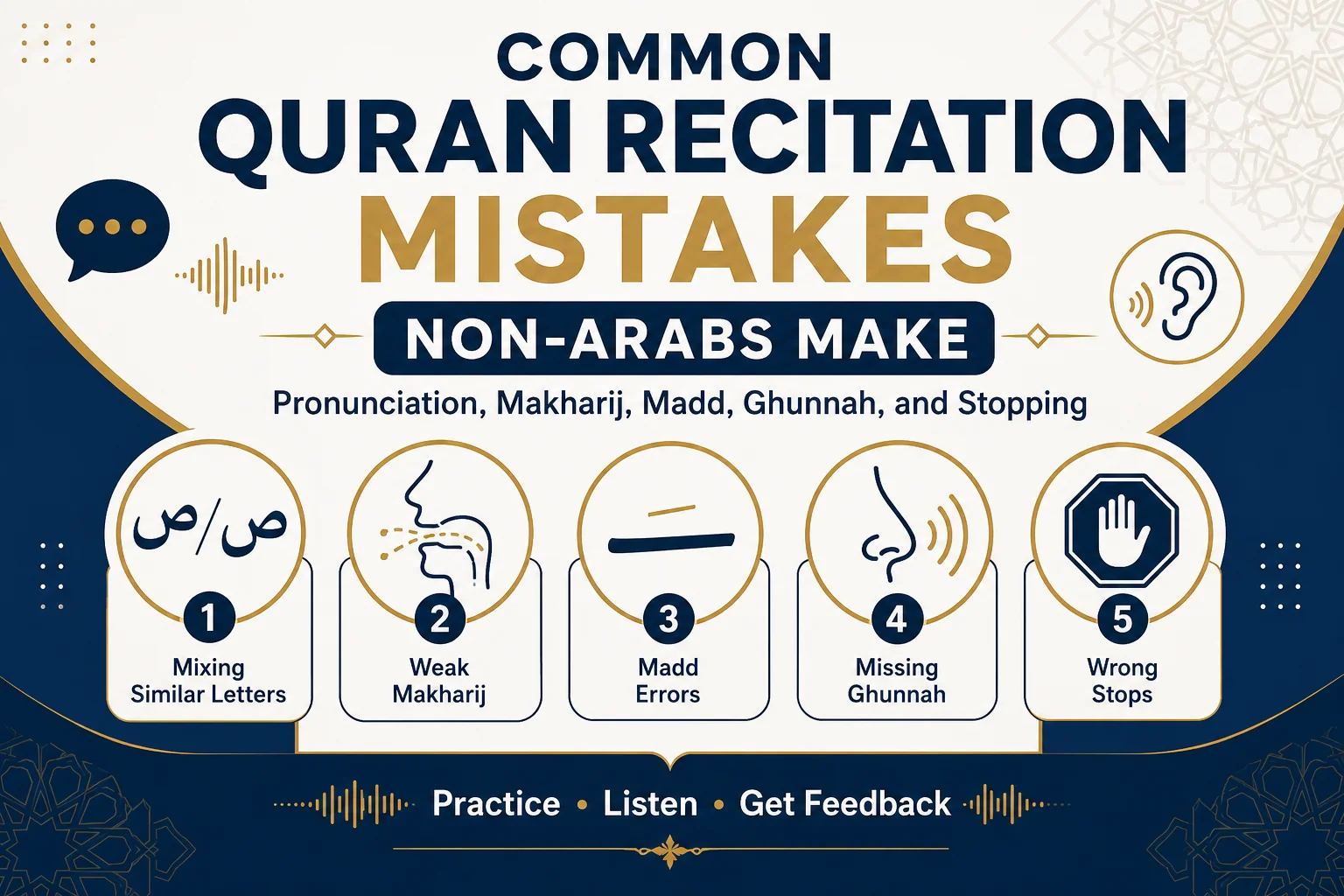
Common Tajweed Mistakes Beginners Make
Removing Ghunnah too quickly
Ghunnah is a nasal sound. It comes through the nose, not only the mouth.
Beginners often remove the Ghunnah too quickly. Others make every noon and meem sound nasal, even when the rule does not require it. A useful practice is to pay attention to the nose while reciting rules that need Ghunnah.
Stretching Madd too much or too little
Madd means lengthening a vowel sound. It happens with the long vowel letters Alif, Waw, and Ya in specific conditions.
Not every stretch has the same length. Some are short and natural. Others are longer because of a hamzah or sukoon after the Madd letter. Beginners should follow the count taught by their teacher, especially because some details depend on the rule and method of recitation.
Making Qalqalah too strong
Qalqalah is a light echo or bounce on certain letters when they have sukoon. The letters are commonly taught together as:
ق ط ب ج د
Beginners often make Qalqalah too strong. They may add a full vowel after the letter. Qalqalah should be a controlled echo, not an extra “a,” “i,” or “u” sound.
Mixing similar Arabic letters
Many non-Arabic speakers struggle with letters that do not exist in their first language. They may mix similar letters because the tongue or throat position feels unfamiliar.
If this happens often, return to letter practice. Tajweed becomes harder when the letters themselves are unstable.
Reading heavy letters too lightly
Some Arabic letters are heavy. They need tafkheem, which means the sound is read with heaviness. Other letters are light and should not be made heavy.
Heavy letters need listening and practice. A written explanation can help, but the ear also needs training.
How to Practise Tajweed Step by Step
Good Tajweed practice is not only reading more. It is reading with attention.
Choose a short passage. Listen to a qualified reciter or your teacher. Pay attention to one rule only. For example, listen only for Ghunnah. Then repeat. Do not try to fix every rule in one reading.
Recording can also help. Many students think they are stretching Madd correctly until they hear themselves rush it. Use short recordings. One or two lines are enough.
A teacher can correct small details that are hard to catch alone. This includes letter exits, heavy letters, Ghunnah timing, Madd length, and stopping rules.
Related Learning Links
- online Quran classes
- online Quran classes for kids
- Quran memorization online
- Noorani Qaida online
- online Quran recitation classes
- Quran Tajweed course
- Quran memorization courses
Simple Review Before Moving Forward
Am I pronouncing the Arabic letters from the correct place?
This is the first question to check. If the letter itself is weak, the Tajweed rule will also be hard to apply.
Do I know when the noon sound is clear, merged, changed, or hidden?
Noon Sakinah and Tanween rules appear often. They deserve slow practice.
Can I apply the basic Meem Sakinah rules?
These rules are fewer, but they still need attention because the mouth and nose both affect the sound.
Do I hold Ghunnah and Madd correctly?
Do not rush them, and do not stretch them without a rule. Follow the count and correction taught by your teacher.
Can I make Qalqalah without adding a vowel?
Qalqalah should stay controlled. It should not become a full extra sound after the letter.
Do I know which mistakes need teacher correction?
If you are learning at home, structured online Quran classes may help you build consistency. If your main goal is recitation correction, a focused Tajweed course can give you direct practice with feedback. Students who still struggle with letters may need to strengthen their reading first through Noorani Qaida.
The goal is not to rush. The goal is to recite with more care, correct what you can, and keep improving step by step. Tajweed is learned through repetition, correction, and patience.
Frequently Asked Questions
What are the first Tajweed rules beginners should learn?
Beginners should usually start with correct Arabic letters, Makharij, Noon Sakinah and Tanween, Meem Sakinah, Ghunnah, Madd, Qalqalah, and heavy and light letters.
Can I learn Tajweed without knowing Arabic?
A beginner can start learning Tajweed without full Arabic understanding, but they still need to learn Arabic letters, sounds, and pronunciation carefully.
What is the difference between Tajweed and Arabic reading?
Arabic reading helps you read the letters and words. Tajweed helps you recite with correct pronunciation, sound rules, stretching, nasal sounds, and stopping.
Do I need a teacher to learn Tajweed?
A teacher is strongly helpful because Tajweed depends on sound. A teacher can hear mistakes that a beginner may not notice alone.
What is Ghunnah in Tajweed?
Ghunnah is a nasal sound that comes through the nose in specific Tajweed rules.
What is Madd in Tajweed?
Madd means stretching a vowel sound in specific conditions. The length depends on the type of Madd and how it is taught in recitation.
What is Qalqalah?
Qalqalah is a light echo or bounce on certain letters when they have sukoon. It should not become an added vowel.
Share this article
Start Your Quran Journey Today
Book 2 FREE trial lessons with a certified teacher — no credit card required.
Book 2 FREE Trial Lessons