General
Online Quran Classes for Kids in Canada: What Parents Should Check Before Enrolling

Online Quran Classes for Kids in Canada: What Parents Should Check Before Enrolling
You found three academies.
One says your child can read fluently within months.
Another says its teachers are certified but never explains by whom.
A third looks professional, offers flexible timing, and has glowing reviews. But you still do not know what your child will actually learn.
That is where many parents get stuck.
Choosing online Quran classes for kids is not just about finding a teacher with an open time slot. You are choosing who will listen to your child’s recitation, correct their mistakes, shape their habits, and speak to them when they struggle.
So the question is not only, “Which class is best?”
The better question is, “What should I check before I trust this class with my child?”
First, know what kind of Qur’an class your child needs
Parents often use “Qur’an class” for different subjects.
That causes problems.
A child may need reading basics, but the parent enrolls them in Hifz.
A child may already read, but the class keeps them on beginner letters.
A child may memorize short Surahs well, but still cannot read from the Mushaf.
Before you compare academies, identify the actual need.
Reading and recitation
Reading classes help children recognize Arabic letters, join letters, read words, and move toward reading from the Mushaf.
This is usually the right starting point for beginners.
If your child does not know the letters well, start with reading. A course like Noorani Qaida for beginners can help build the foundation before longer recitation or memorization.
Do not rush this stage.
If a child cannot read independently, memorization may hide the weakness for a while. The child repeats after the teacher but still cannot read alone.
Tajweed
Tajweed is not just “nice recitation.”
It is careful correction.
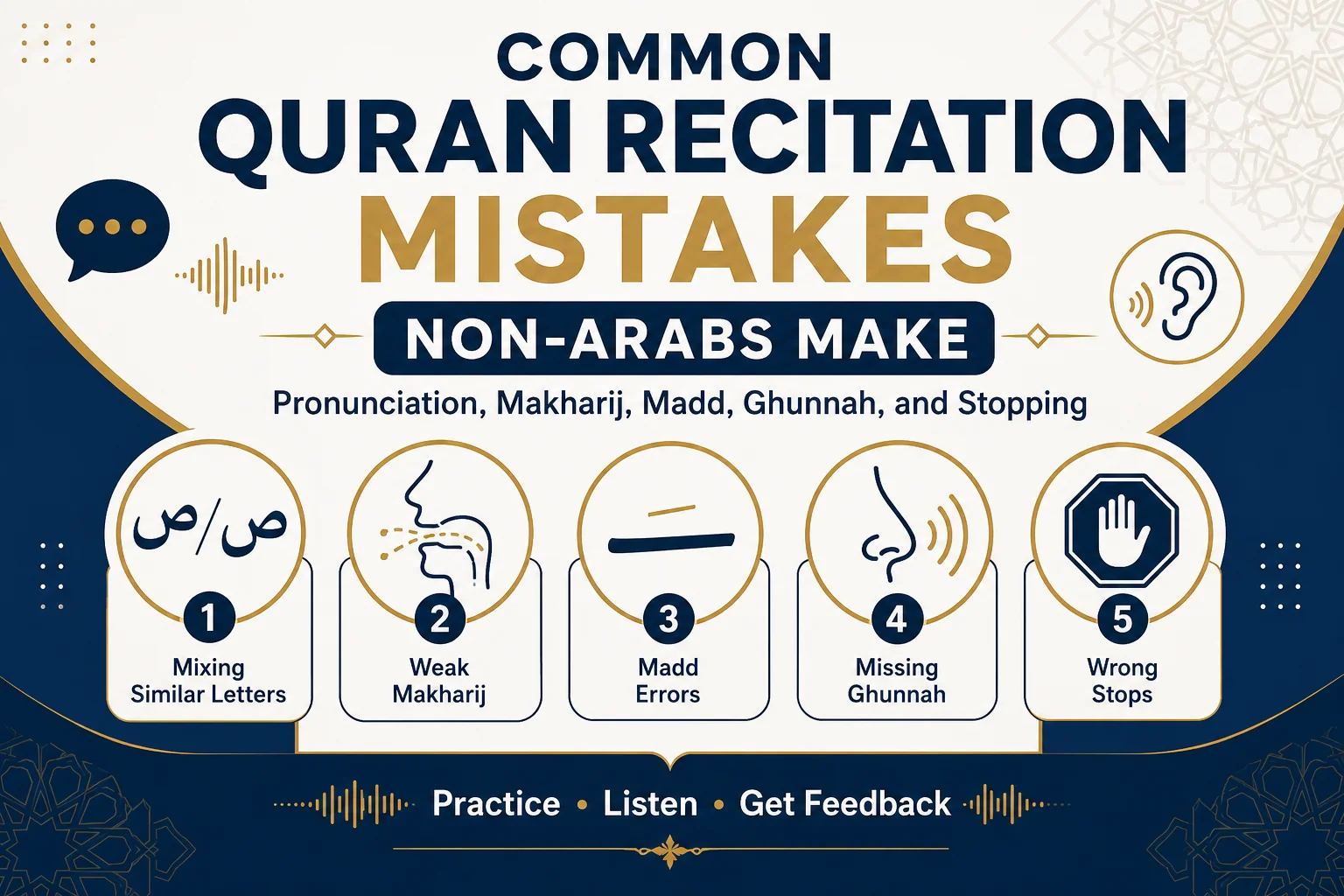
The teacher listens for pronunciation, letter qualities, elongation, stopping, and common reading mistakes. A child may be able to read Arabic and still need Tajweed correction.
For many children, Tajweed should begin with listening and imitation before heavy rule names.
A teacher may later explain terms such as Makharij, madd, ghunnah, and qalqalah. But young learners first need clean habits.
For parents who want to understand this path more clearly, a structured Qur’an Tajweed course can show how Tajweed learning is usually separated from basic reading.
Hifz and memorization
Hifz is a serious commitment.
It needs revision, regular practice, and patience. It should not be treated like a race.
Some children are ready for memorization early. Others need more reading fluency first. Some can memorize well but become overwhelmed when the daily revision grows.
If you are considering memorization, look for a clear plan. Ask how much new memorization is added, how often old portions are revised, and what happens when the child forgets.
A dedicated Quran memorization course should explain revision, pacing, and teacher feedback, not only the amount a child may memorize.
You may also review how other academies describe Qur’an memorization courses so you can compare structure, revision, and expectations before choosing a program.
Islamic studies and Arabic
Islamic studies, Arabic language, and Qur’an recitation are connected.
But they are not the same class.
A child may study Islamic manners and still need recitation correction.
A child may learn Arabic vocabulary and still struggle with reading from the Mushaf.
Keep the goals separate in your mind. Then ask the academy what exactly your child will study.
Check your child’s readiness before checking the timetable
Age matters less than readiness.
Some six-year-olds can sit, listen, repeat, and handle correction.
Some nine-year-olds need shorter lessons and more encouragement.
Before enrolling, ask yourself:
- Can my child focus for 20 to 30 minutes?
- How do they respond when corrected?
- Can they repeat after a teacher without becoming upset?
- Do they need me nearby during class?
- Is our home quiet enough at that time?
- Can we practise between lessons?
This last question matters.
Online Qur’an learning does not work well when parents treat the teacher as the only person responsible. You do not need to be a scholar. You do not need to correct Tajweed yourself. But your child needs routine, a quiet space, and someone at home who treats the lesson seriously.
A class may be good, but if the child joins tired, distracted, or unprepared every time, progress will be slow.
Check the teacher before the price
The teacher matters more than the platform.
A child learns Qur’an through listening, correction, repetition, and trust. If the teacher is harsh, distracted, unclear, or careless with pronunciation, the class will suffer.
A suitable Qur’an teacher for kids should have:
- sound recitation
- working Tajweed knowledge
- experience teaching children
- patience with mistakes
- clear English if the child needs English explanation
- good class control without intimidation
- respect for the child’s age and confidence
Ask direct questions.
- Who will teach my child?
- What is the teacher’s training?
- Has the teacher taught children at this age?
- Can the teacher explain in English?
- Can I observe the first class?
- How are teachers supervised?
- What happens if the teacher is not a good fit?
Be careful with the word “certified.”
A certificate can mean many things. It may refer to a short training course, a Tajweed qualification, an ijazah, or an academy’s own internal approval.
Ask what it means.
A serious teacher or academy should not be offended by that question.
Ask how Tajweed is corrected online
Do not accept “we teach Tajweed” as a complete answer.
Ask how the teacher actually corrects mistakes.
A good answer may include:
- listening to the child read aloud
- modelling the sound clearly
- asking the child to repeat
- correcting one or two mistakes at a time
- using video when mouth position matters
- giving home practice notes
- revisiting the same mistake in later lessons
Some children need the teacher to show the sound.
Some need the teacher to slow the word down.
Some need the teacher to compare two similar letters.
This is why live correction matters. A recorded video can explain a rule, but it cannot hear your child’s mistake.
For families looking specifically at recitation correction, online Quran recitation classes may help them compare recitation-focused learning with broader Qur’an class options.
Choose the class format that fits your child
One-on-one classes can help a child who needs focused correction.
They may suit:
- shy children
- beginners
- children with pronunciation issues
- children who need flexible pacing
- teenagers who dislike making mistakes in front of others
Small group classes can also work.
They may suit:
- children who enjoy peers
- siblings at a similar level
- learners who need social energy
- students who benefit from listening to others read
Do not use a lazy rule.
One-on-one is not always better.
Group is not always weaker.
The better choice depends on your child’s level, temperament, confidence, and learning goal.
During a trial class, watch how the teacher handles pace. If it is a group, does one child dominate? Does the quiet child get heard? Does the teacher correct without embarrassing anyone?
That will tell you more than the class label.
Match the class to your child’s age
A four-year-old does not learn like a nine-year-old.
A teenager does not want to be treated like a small child.
Younger children
For children around four to six, look for:
- short lessons
- simple repetition
- letter recognition
- gentle correction
- movement breaks if needed
- a teacher who can handle distraction
Do not expect long sitting.
Do not expect adult-style Tajweed explanation.
At this age, a parent may need to stay nearby.
Children seven to eleven
This age can often handle more structure.
A class may include:
- Noorani Qaida
- short Surah reading
- basic Tajweed habits
- memorization with revision
- simple homework
The teacher should still keep goals realistic.
A child who attends school all day may not manage a heavy Qur’an schedule every evening.
Teenagers
Teenagers need respect.
Some are starting late. Some have gaps. Some feel awkward reading in front of others.
A good teacher protects their dignity.
For teens, ask:
- Will the teacher assess without embarrassing them?
- Can the class focus on fluency and confidence?
- Can the teacher explain Tajweed clearly?
- Is the schedule realistic around exams and schoolwork?
Ask for a real learning plan
A structured plan does not mean every child follows the same path.
It means the teacher knows where the child is starting and what the next step should be.
Before enrollment, ask what your child may learn in the first month.
A useful answer sounds specific.
For example:
- first, letter recognition and short vowels
- then joined letters and simple words
- then short Surahs with correction
- then fluency, revision, and Tajweed habits
That is only an example.
Your child may move faster or slower.
Speed is not the main point. Clarity is.
A useful learning plan should include:
- starting level assessment
- weekly reading target
- revision target
- correction notes
- parent feedback
- clear next step
If the academy cannot explain the plan, pause.
If the teacher says “we will see” but gives no structure, pause.
If the plan is all memorization with no revision, pause.
Check how progress is measured
Parents do not need complicated dashboards.
They need clear feedback.
Useful feedback sounds like this:
- “Your child recognizes most letters but needs work on joined forms.”
- “They are stretching short vowels.”
- “They need to revise the last three lines before adding new memorization.”
- “They read better when the lesson is earlier in the evening.”
- “They are rushing at stopping points.”
Weak feedback sounds like this:
- “Good.”
- “Needs more practice.”
- “Doing fine.”
- “Almost fluent.”
Ask how often parents receive updates.
Ask whether the teacher gives correction notes.
Ask whether attendance, revision, and reading mistakes are tracked.
A dashboard helps only if the teacher’s notes are specific.
Online safety is part of the amanah
Parents should not treat an online Qur’an class like a recorded lesson.
This is a live adult-child interaction.
It needs rules.
Ask:
- Can parents observe lessons?
- Are lessons recorded?
- Who can access recordings?
- Can teachers message children directly?
- Are class links private?
- What happens if a child feels uncomfortable?
- Who handles complaints?
- What child data is collected?
- Is there a privacy policy?
Before the first class, tell your child:
- You can tell me if anything feels strange.
- You do not need to answer personal questions.
- You do not need to continue a class if you feel uncomfortable.
- You can ask me to stay nearby.
Do not accept vague answers from an academy.
“Safe and secure” is not enough.
You need to know the actual rules.
Use the trial class properly
A trial class is not only for the child.
It is for the parent too.
During the trial, watch the teacher more than the screen.
Look for:
- Does the teacher greet the child properly?
- Does the teacher check the level before teaching?
- Does the teacher correct gently?
- Does the teacher listen carefully?
- Does the teacher explain mistakes in a way the child understands?
- Does the child look tense, bored, confused, or comfortable?
- Does the teacher keep the lesson moving?
- Does the teacher give a clear next step?
After the class, ask your child:
- Did you understand the teacher?
- Did you feel okay reading?
- Was anything too hard?
- Would you want another class with this teacher?
Do not ask only, “Did you like it?”
Some children say yes to please parents.
Ask what happened in the class.
Red flags to take seriously
A weak class often shows signs early.
Be careful if you see:
- fast Hifz promises
- no level assessment
- no parent observation
- vague teacher credentials
- harsh correction
- too much homework
- no revision plan
- no clear Tajweed correction
- no attendance or progress notes
- pressure to enroll immediately
- unclear pricing
- private teacher-child messaging without parent visibility
Also be careful with polished language.
A website may say “best online Quran classes,” but your child still needs the right teacher.
A website may say “certified tutors,” but you still need to know what that means.
A website may say “safe,” but you still need supervision, communication rules, and privacy clarity.
Green lights that matter
Good signs are usually simple.
Look for an academy or teacher that can explain:
- the teacher’s background
- the child’s starting level
- what happens in the first few weeks
- how Tajweed mistakes are corrected
- how home practice should work
- how parents receive feedback
- what happens if the child struggles
- how missed lessons are handled
- whether the teacher can adjust pace
The best sign is not fancy wording.
It is a teacher who understands your child’s level and can explain the next step clearly.
Do not choose only by price
Price matters.
Families have budgets.
But the cheapest class is not always the best value, and the most expensive class is not always the strongest.
Judge by fit.
Ask:
- Is the teacher suitable?
- Is the class length right?
- Is there feedback?
- Is revision included?
- Are missed classes handled fairly?
- Does the child respond well?
- Is the schedule sustainable?
A class that your child dreads is expensive even when the fee is low.
A class that is too intense may break consistency.
A class that is gentle but unclear may not build skill.
Look for balance.
Home practice makes the class work
A common mistake is thinking, “I paid for the class, so the teacher will handle everything.”
That is not how children learn Qur’an well.
You do not need to correct every mistake.
You do need to create the conditions for practice.
Set up a quiet place. Keep the device charged. Remove distractions. Keep siblings away if possible. Make sure the child joins on time.
On non-class days, ask your child to review what the teacher assigned.
Even ten or fifteen focused minutes can help if it happens often.
Your presence matters.
Not because you are the teacher.
Because your child sees that Qur’an learning has a place in the home.
What parents should not expect
Do not expect a beginner to become fluent quickly just because the class is online.
Do not expect Hifz without daily revision.
Do not expect Tajweed to be fixed by memorizing rule names.
Do not expect a teacher to succeed if the schedule is always rushed and the child never practises.
Do not expect online learning to be the same as studying in person.
Both can be useful. They are different.
Online learning can offer flexibility and access to teachers outside your local area. In-person learning may offer community and a stronger local connection.
Choose what works for your child and your family.
Questions to ask before enrolling
Use these before choosing Qur’an classes for children:
- What level will my child start at?
- Will my child learn Noorani Qaida, recitation, Tajweed, Hifz, Islamic studies, or a mix?
- Who is the teacher?
- What experience does the teacher have with children?
- Can the teacher explain in English?
- Can I observe the first class?
- How will you correct pronunciation online?
- How much revision is included?
- What should we practise at home?
- What happens if my child misses a class?
- Are there evening or weekend times that fit our Canadian schedule?
- How often will parents receive feedback?
- Can I change teachers if the fit is not right?
- What safety rules govern teacher-child communication?
- What data or recordings do you keep?
These questions protect your child from confusion.
They also help the academy place the child properly.
A balanced way to choose
The right class should help your child move with steadiness.
Not panic.
Not pressure.
Not random lessons.
Look for:
- accuracy before speed
- consistency before intensity
- revision before new memorization
- teacher fit before platform claims
- safety before convenience
- parent feedback before blind trust
For some children, online Qur’an learning works well.
For others, a local teacher or mosque class may be better.
Many families use both.
The question is not whether online is always better.
The question is whether this class, this teacher, and this schedule serve your child well.
A calm next step
If your family is considering online Qur’an classes, a trial lesson can help when it is treated as an assessment, not a sales step.
At Al Quran Recitation Academy, parents can use the first class to understand their child’s level, hear how Tajweed correction is handled, ask about Arabic reading or memorization goals, and see whether the teacher’s pace feels sustainable.
You can also review the academy’s online Quran classes and Quran classes for kids to see which path fits your child’s current level.
There is no need to rush the decision.
A steady class, clear feedback, and a realistic routine usually serve children better than big promises.
FAQ
What should parents check before choosing online Quran classes for kids?
Check the teacher, class format, curriculum, safety rules, parent feedback, schedule, and trial class.
Do not choose based only on price or claims.
Are online Qur’an classes suitable for kids in Canada?
They can be suitable when the teacher is qualified, the timing fits school life, parents can stay involved, and the child is comfortable with the format.
They are not automatically the best option for every child.
What age should a child start Qur’an classes?
Some children start with letters around four to six.
Others start later and do well.
Readiness matters more than age alone. The child should be able to listen, repeat, and sit for a short lesson without distress.
Should my child start with Noorani Qaida, Tajweed, or Hifz?
If your child cannot read Arabic letters and joined words, start with Noorani Qaida or reading basics.
If your child can read but makes recitation errors, focus on Tajweed correction.
If your child reads well and can revise consistently, memorization may be added.
Are one-on-one Quran classes better for kids?
Sometimes.
One-on-one classes help with focused correction. Small group classes may help children who enjoy peer learning.
The better choice depends on your child’s age, confidence, level, and personality.
Can Tajweed be taught online?
Yes, Tajweed correction can be taught online when the teacher can hear the child clearly, correct mistakes carefully, and give regular feedback.
The audio quality, teacher skill, and child attention all matter.
Should parents choose a female Quran teacher for kids?
Some families prefer a female teacher, especially for daughters or younger children.
That can be a valid preference.
Still check teaching ability, Tajweed knowledge, communication style, and safeguarding. Gender alone does not prove teaching quality.
How many lessons per week should a beginner take?
Many beginners do better with short, consistent lessons.
The right number depends on age, attention span, school workload, and home revision.
Two steady lessons with practice may help more than five rushed lessons with no review.
What if my child feels pressured?
Pause and ask why.
The portion may be too long. The teacher may be too strict. The timing may be poor. The child may need more revision.
Do not ignore repeated stress. Qur’an learning should be treated with seriousness, but children still need patience and a pace they can carry.
Ready to start? Visit our dedicated Online Quran Classes in Canada page for evening slots in your province, female teachers, and two free trial lessons.
Share this article
Start Your Quran Journey Today
Book 2 FREE trial lessons with a certified teacher — no credit card required.
Book 2 FREE Trial Lessons