Quran Learning
Online Quran Classes for Kids in Australia: What Parents Should Check Before Enrolling
Online Quran Classes for Kids in Australia: What Parents Should Check Before Enrolling
“My child knows some Arabic letters, but I’m not sure if they should start Tajweed or Hifz.”
Many parents reach this point.
A child may recognise letters but struggle when those letters join. Another child may recite short Surahs from memory but find it hard to read from the Mushaf. A teenager may want to start but feel embarrassed because younger children already read better.
That is why choosing online Quran classes for kids should not begin with price, timing, or a polished course page.
It should begin with a simpler question.
What does my child need next?
For Muslim families in Australia, online learning can make Qur’an lessons easier to fit around school, travel, mosque, homework, and family life. But flexibility only helps when the class matches the child’s level. A child still needs a suitable teacher, clear correction, regular revision, and support at home.
Why Australian Parents Look for Online Quran Classes for Kids
Many parents in Australia want Qur’an learning to become part of normal family life.
The routine can be difficult.
A child may come home from school tired. Weekend mosque classes may clash with family plans. A local teacher may not be nearby. Some families live in smaller towns where regular Qur’an classes are harder to find.
Online Quran classes for kids can help because the child can learn from home. Families may choose weekday evenings, weekends, or school-holiday lessons when these options are available.
But one mistake causes problems.
Flexible does not mean unplanned.
A child who studies every Tuesday and Thursday after Maghrib will usually have a clearer routine than a child who studies whenever there is spare time. Qur’an learning needs rhythm. Even a short routine can help when it is steady.
What Online Quran Classes Can Mean
Not every Qur’an class teaches the same thing.
Before enrolling, parents should ask what the class actually covers.
Noorani Qaida for Beginners
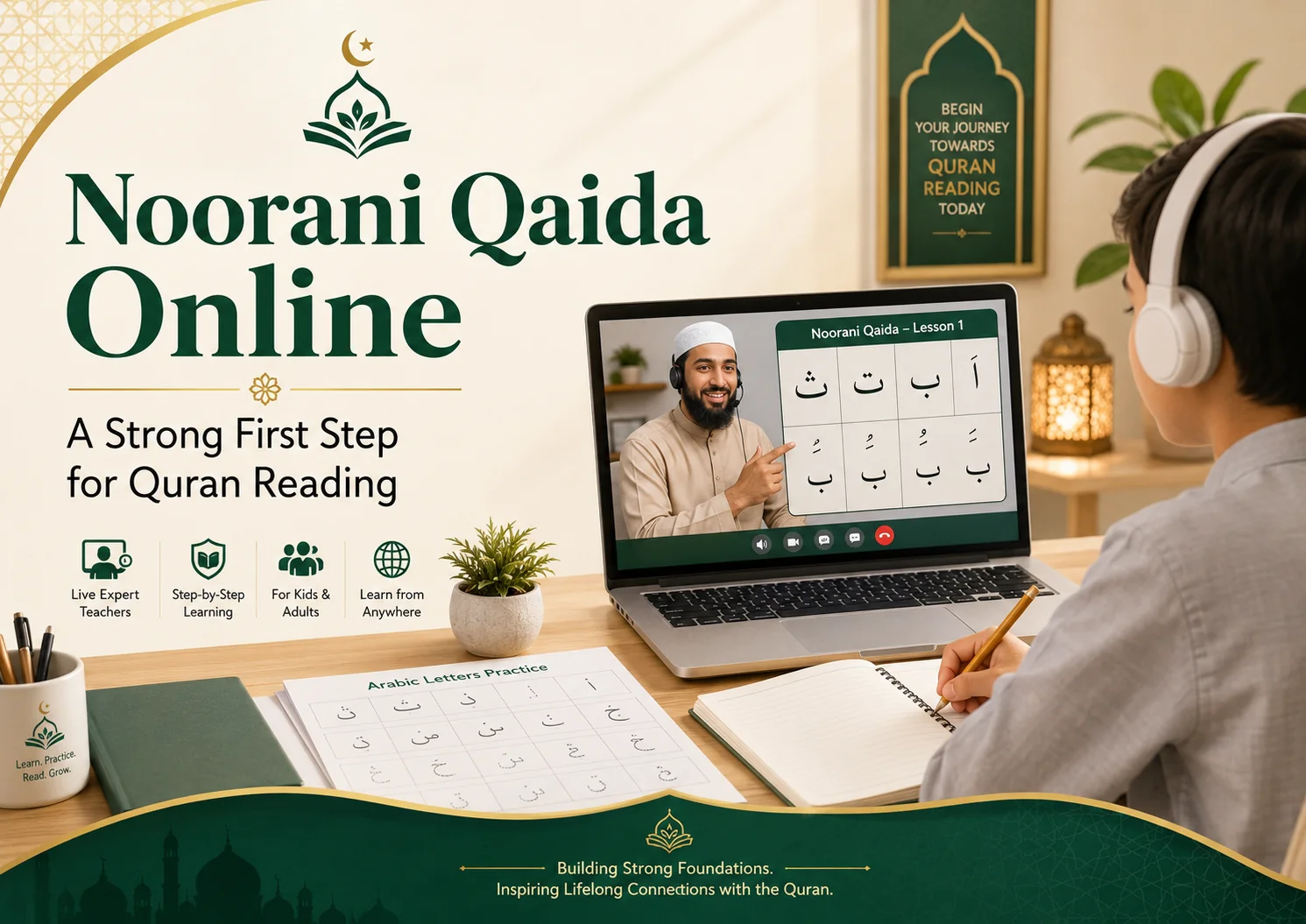
Noorani Qaida is often used for children who are still learning Arabic letters, sounds, joined letters, and basic reading patterns.
This is usually a better starting point for a child who cannot yet read Arabic words.
A beginner should not be rushed into full Qur’an reading if they still confuse letters such as ب, ت, ث or struggle when letters join together.
Qur’an Reading and Recitation
Some children know the letters but need reading practice.
At this stage, the teacher helps the child read from the Mushaf with correction. The focus is usually accuracy, confidence, and steady reading.
This is not the same as memorising.
A child may know Surah Al-Fatihah by heart and still need help reading new verses from the page.
Tajweed for Kids
Tajweed for kids should be taught with care.
Young children do not need a heavy lesson filled with terms they cannot use. They need clear examples, repeated practice, and careful correction.
For example, a teacher may help the child hear the difference between ق and ك, or between ح and ه.
The aim is not to make the child sound impressive. The aim is to help the child recite more correctly, step by step.
Hifz and Memorization
Hifz classes for kids can suit some children, but not every child is ready.
A child who cannot read well may still memorise by listening. That may help in the short term, but it can create gaps later if there is no reading foundation.
Hifz also needs revision. New memorization becomes weak when old portions are not reviewed.
Parents should ask:
- Can my child revise what they already memorised?
- Can they sit with focus?
- Can they handle correction without feeling pressured?
- Does the teacher have a clear revision plan?
How to Know Your Child’s Starting Level
A good online Quran teacher for kids should not place every child into the same program.
The first step should be checking the child’s level.
Complete Beginner
This child does not know Arabic letters well.
They usually need letters, sounds, and short reading exercises.
A shorter lesson may work better than a long one.
Knows Letters but Cannot Read Words
This child may recognise individual letters but struggle when they join.
Noorani Qaida for kids can help here.
The teacher should slow down and build reading habits before moving to longer Qur’an passages.
Reads Slowly from the Mushaf
This child needs guided recitation.
The teacher should correct pronunciation, pauses, and repeated mistakes.
Progress should be measured by better reading, not only by reaching the next page.
Memorises Short Surahs but Cannot Read Independently
This is common.
The child may have memorised by listening at home or in class. That is useful, but it does not replace reading skills.
Parents do not need to feel embarrassed. The next step is to connect memorization with reading.
Teenagers Starting Late
Teenagers need a careful tone.
They may feel shy, especially if younger siblings read better. A good teacher should protect their confidence and teach without shame.
For teenagers, private one-on-one Quran lessons may help because they reduce embarrassment.
Choosing the Right Class Type
Online Qur’an learning does not come in one format.
One-on-One Classes
One-on-one classes can help children who need direct correction.
They may suit:
- shy children
- beginners
- children with pronunciation mistakes
- children preparing for Hifz
- teenagers starting late
The teacher can listen closely and adjust the pace.
Still, one-on-one is not automatically better for every child. Some children enjoy learning with a sibling or a small group.
Small Group Classes
Small groups can work when children are close in level.
They may help a child feel less alone. They may also be more affordable.
The risk is that a quiet child may receive less correction. Parents should ask how often each child reads during the lesson.
Short Lessons for Young Children
A four-year-old and a ten-year-old should not have the same lesson style.
Young children often need shorter sessions, repetition, and simple tasks. They may start with letters, sounds, and listening.
Parents should not judge progress only by pages completed.
Structured Lessons for Older Children
Older children can usually handle more structure.
They may work on reading fluency, Tajweed rules, memorization, or revision.
Even then, a child with school pressure may not manage several lessons per week. More classes do not always mean better learning.
Can Children Learn Tajweed Online?
Yes, Tajweed can be taught online when the setup is suitable.
But it needs more than a video call.
The teacher must hear the child clearly. The child needs a quiet place. The internet connection should be stable. A headset may help if the room is noisy.
Parents should also understand what Tajweed correction looks like.
A careful teacher may stop the child often at first. This is normal. Correction is not failure. It is part of learning.
But correction should not become harsh.
A child who feels attacked may begin avoiding recitation. The teacher should correct clearly, then let the child try again.
When Hifz Makes Sense for Kids
Some parents want their child to begin Quran memorization early.
That can be suitable when the child is ready and the home routine supports it.
But Hifz should not become a race.
A child needs:
- a manageable portion
- regular revision
- accurate recitation
- parent support
- enough sleep and focus
- a teacher who notices weak memorization
If the child forgets old lessons while adding new ones, the plan needs adjustment.
For many children, stronger reading and Tajweed should come before a serious Hifz schedule.
What to Check in an Online Quran Teacher for Kids
A good teacher for adults is not always a good teacher for children.
Children need patience, structure, and simple correction.
Before choosing an online Quran tutor for kids, ask these questions.
Can the Teacher Correct Recitation Clearly?
The teacher should notice repeated mistakes.
For example:
- wrong letter sounds
- stretching where there should be no stretch
- stopping in the wrong place
- rushing through words
- mixing similar letters
Parents do not need to know every Tajweed rule. But they should be able to see that the teacher listens carefully.
Does the Teacher Work Well With Children?
A child may lose focus. They may move around. They may answer slowly.
The teacher should know how to bring the child back without anger.
Firm does not mean harsh.
Can the Teacher Explain in English?
For English-speaking Muslim children in Australia, clear English can help.
The child may need simple explanations such as:
“Read this sound from the throat.”
“Do not stretch this letter.”
“Try that word again slowly.”
A teacher who only corrects by repeating may not be enough for every child.
Are Male and Female Teacher Options Available?
Some families prefer a female Quran teacher for kids, especially for daughters or younger children.
That preference is understandable.
But teacher quality still matters.
Parents should ask about experience, teaching method, and communication, not only gender.
Online Safety Questions Parents Should Ask
Safety should not be treated as a slogan.
Parents should ask practical questions before lessons begin.
Can Parents Observe Lessons?
For younger children, parents should be able to check the lesson environment.
They do not need to sit through every minute, but they should know what is happening.
How Does Communication Happen?
Teacher-child communication should be clear and appropriate.
Parents should know:
- who contacts the child
- which platform is used
- whether messages go through the parent
- what happens if a teacher needs to reschedule
Are Lessons Recorded?
Some academies record lessons for revision or quality checks.
If lessons are recorded, parents should know how recordings are stored and who can access them.
What Happens if the Child Feels Uncomfortable?
There should be a clear way to report concerns.
A parent should never feel awkward asking this.
Australian Schedule Considerations
Families in Australia may need class times that work across AEST, ACST, or AWST.
A family in Sydney may prefer a different time from a family in Perth. Younger children may learn better before they get too tired. Older children may need lessons after homework.
Good scheduling is not only about finding an empty slot.
Ask:
- Will my child be alert at this time?
- Will dinner interrupt the lesson?
- Is the lesson too close to bedtime?
- Can we revise for five minutes before the next class?
A simple routine is often better than an ambitious one.
How Parents Can Support Quran Learning at Home
Parents do not need to be Qur’an teachers to support their child.
They can help by creating the right environment.
A few useful habits:
- keep the lesson time consistent
- prepare the device before class
- choose a quiet place
- remind the child to revise
- ask the teacher what to practise
- praise effort, not speed
- avoid comparing siblings
A child who reads one line correctly with focus has made real progress.
Do not make every lesson about finishing more.
Red Flags Before Enrolling
Be careful if a class or teacher promises too much.
Avoid programs that say:
- guaranteed fluency
- fast Hifz
- master Tajweed quickly
- best teacher for every child
- results in a fixed number of months
Children learn at different speeds.
Also be careful if:
- teacher qualifications are unclear
- there is no level check
- there is no revision plan
- parents receive no feedback
- the child is pushed into Hifz too early
- safety rules are vague
- every child receives the same lesson plan
A serious Qur’an class should welcome parent questions.
Questions to Ask Before the First Class
Before enrolling your child, ask:
- What level will my child start at?
- Will the teacher check reading before choosing the course?
- Is this class for Qaida, recitation, Tajweed, or Hifz?
- How often will my child revise?
- How will you correct pronunciation?
- Can I receive feedback after lessons?
- Can I choose a male or female teacher?
- What happens if my child struggles to focus?
- How do you handle online safety?
- How many lessons per week do you recommend for my child’s age?
These questions protect your child from being placed in the wrong class.
A Balanced Way to Decide
Online Quran classes for kids can be a good option for Australian families.
They can help when local access is limited, schedules are busy, or a child needs personal recitation correction.
But online classes are not magic.
The teacher matters.
The child’s level matters.
The home routine matters.
Parent involvement matters.
Some children may do well with online lessons. Others may benefit from a local mosque teacher, a weekend class, or a mix of both.
The right choice is the one that helps your child learn with accuracy, consistency, and respect.
A Soft Next Step for Parents
If you are unsure where your child should begin, Al Quran Recitation Academy can help you check the right starting point.
Some children need Noorani Qaida. Some need Quran recitation practice. Some are ready for Tajweed correction. Others may need a careful Quran memorization plan with revision.
You can also explore the academy’s Quran classes for kids and ask which path fits your child’s current level.
The goal is not to rush enrollment.
The goal is to place the child where learning can continue with care.
FAQs About Online Quran Classes for Kids in Australia
Are online Quran classes for kids suitable for beginners?
Yes, beginners can learn online if the class starts at the right level.
A complete beginner may need Arabic letters, sounds, and Noorani Qaida before reading longer Qur’an passages.
What age should a child start online Quran classes?
There is no single age for every child.
Some young children can begin with short lessons and letter recognition. Others need more time before they can sit, listen, and repeat with focus.
Readiness matters more than age.
Should my child start with Noorani Qaida, Tajweed, or Hifz?
A beginner usually starts with Noorani Qaida or basic reading.
A child who reads from the Mushaf may begin recitation correction and Tajweed.
Hifz should come with a clear revision plan and should match the child’s ability.
Can Tajweed be taught properly online?
It can be taught online when the teacher can hear the child clearly and correct mistakes with care.
A quiet room, stable internet, and regular practice help.
Are one-on-one Quran classes better for kids?
One-on-one classes can help children who need more correction or attention.
Small groups can also work when children are at a similar level.
The best choice depends on the child.
How many Quran lessons per week should a child take?
It depends on age, school routine, attention span, and revision habits.
Two steady lessons with revision may be better than many rushed lessons.
Can my child learn Quran online after school in Australia?
Yes, many families choose after-school or weekend lessons.
The class time should fit the child’s energy level, not only the parent’s calendar.
Should I choose a female Quran teacher for my child?
Some families prefer a female teacher, especially for daughters or younger children.
That can be a good preference.
Still, parents should also check teaching skill, patience, recitation correction, and communication.
How do I know if a Quran teacher is qualified?
Ask what the qualification means.
Ask about recitation training, Tajweed background, teaching experience with children, and how the teacher handles mistakes.
Do not rely only on the word “certified.”
Is Hifz suitable for every child?
No.
Some children are ready for memorization. Others need stronger reading first.
Hifz requires revision, patience, and a realistic plan.
What should parents do between lessons?
Ask the teacher for a short practice task.
Then help the child revise it calmly.
Five focused minutes can help more than a long session filled with pressure.
Ready to start? Visit our dedicated Online Quran Classes in Australia page for weekend-morning and evening slots in your state, female teachers, and two free trial lessons.
Share this article
Start Your Quran Journey Today
Book 2 FREE trial lessons with a certified teacher — no credit card required.
Book 2 FREE Trial Lessons