Quran Learning
How to Memorize Quran Efficiently Without Weak Tajweed
Learn how to approach Quran memorization with steady Hifz, clear Tajweed, teacher correction, and regular Muraja’ah without rushing into weak recitation.
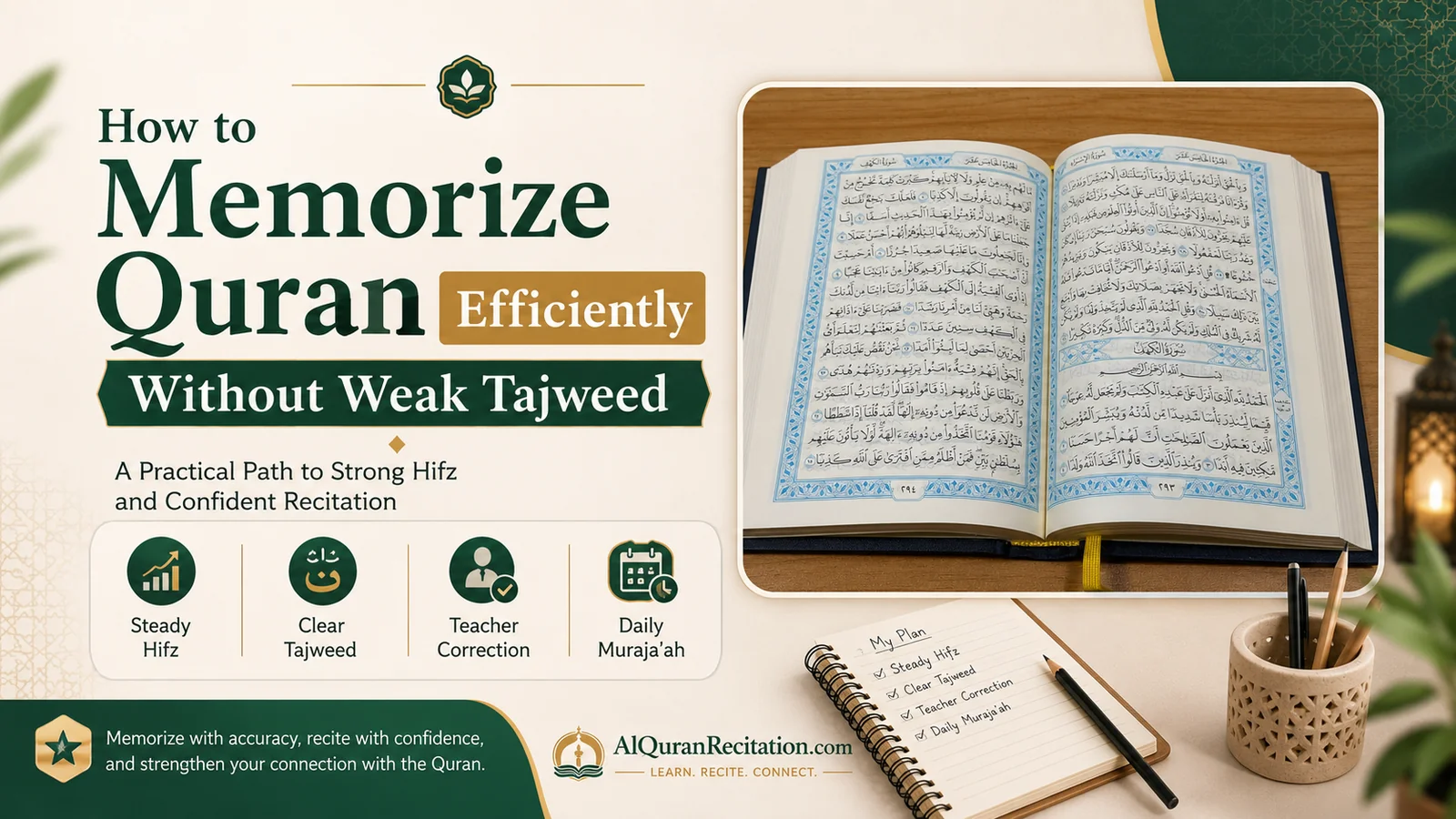
How to Memorize Quran Efficiently Without Weak Tajweed
Are you trying to memorize more Quran, but your Tajweed is starting to slip?
That is a common problem. A student increases the daily Hifz portion, feels pleased with the extra lines, then later hears the same correction again and again. The words are memorized, but the pronunciation is not stable.
That kind of speed does not save time. It creates more work later.
A better plan is to memorize at a pace that protects recitation, review, and correction. This matters whether you study in a local class, with a private teacher, or through Quran memorization online.
Why Rushing Hifz Can Weaken Tajweed
Rushing Hifz usually leads to three problems.
- The student memorizes pronunciation mistakes.
- The student spends too much time on new pages and too little time on review.
- The student becomes used to an incorrect sound pattern.
For example, a beginner may mix heavy and light letters, stretch a short vowel, or miss the correct exit point of a letter. If the same mistake is repeated many times during memorization, it starts to feel normal. Later correction becomes harder.
The Quran teaches careful recitation. Allah says:
وَرَتِّلِ الْقُرْآنَ تَرْتِيلًا
“And recite the Quran with measured recitation.”
Surah Al-Muzzammil, 73:4
This verse does not point a learner toward careless speed. It points toward measured recitation, clarity, and attention.
Mistakes become harder to fix after memorization
A Tajweed mistake before memorization is easier to correct. A Tajweed mistake after memorization often needs relearning.
That is why progress should not be measured only by the number of pages finished. A page memorized with repeated errors still needs work.
Speed without review creates weak retention
New memorization feels rewarding. Review can feel slower. But Hifz depends on review.
The Prophet ﷺ warned about the need to keep revising the Quran:
تَعَاهَدُوا الْقُرْآنَ، فَوَالَّذِي نَفْسِي بِيَدِهِ، لَهُوَ أَشَدُّ تَفَصِّيًا مِنَ الإِبِلِ فِي عُقُلِهَا
“Keep reviewing the Quran, for by Him in Whose Hand my soul is, it escapes faster than tied camels.”
Sahih al-Bukhari, Hadith 5033
This hadith is a serious reminder. Hifz is not only about adding new verses. It is also about keeping what you have memorized through regular review.
What Efficient Quran Memorization Means
Efficient memorization is not rushed memorization.
It means:
- You memorize a daily portion that suits your level.
- You correct recitation before repeating it many times.
- You review old portions every day.
- You reduce mistakes that could have been avoided.
- You increase your portion only when your current work is stable.
This is the safer meaning of speed. Not careless pace. Less wasted effort.
Fewer repeated mistakes
If a teacher corrects one sound before you repeat the verse all day, you save time. You also protect your recitation.
For example, if you keep confusing ع and أ, or ق and ك, do not cover that problem with more memorization. Fix the sound first. Then continue.
Better daily consistency
A small daily portion often works better than a large portion once or twice a week.
The Prophet ﷺ said:
أَحَبُّ الأَعْمَالِ إِلَى اللَّهِ أَدْوَمُهَا وَإِنْ قَلَّ
“The most beloved deeds to Allah are those done regularly, even if they are few.”
Sahih al-Bukhari, Hadith 6464
This hadith is not a fixed Hifz schedule. It supports the value of consistency. For Quran memorization, consistency may mean a few lines, half a page, or more, depending on the student.
Stronger Muraja’ah
Muraja’ah means revision. It is not something extra after Hifz. It is part of Hifz itself.
A student who memorizes five new lines and reviews old portions well may be moving in a better direction than a student who memorizes one page but forgets last week’s work.
Build Tajweed Into Hifz From the Start
Some students think Tajweed can wait until after memorization. That habit can cause problems.
If your reading is weak, begin with correction. If you cannot read Arabic letters properly, start with a foundation such as Noorani Qaida online before taking large Hifz portions.
This does not mean you must know every advanced Tajweed detail before memorizing. It means you should not memorize with obvious pronunciation mistakes.
Fix Makharij before increasing the daily portion
Makharij are the articulation points of letters. Weak Makharij can affect the sound of recitation.
A beginner should pay close attention to letters such as:
- ح and ه
- ع and أ
- ق and ك
- س and ص
- ت and ط
- ذ, ز, and ظ
If these sounds are unstable, increasing daily memorization may create more mistakes to fix later.
Listen first, then recite to a teacher
Listening to a skilled reciter can help. But listening alone is not correction.
A student may think they are copying the sound correctly while still making mistakes. This is why reciting to a qualified teacher matters, especially for beginners and non-Arabic speakers.
A teacher can hear mistakes that the student may not notice.
Do not rely on transliteration for long
Transliteration may help a new Muslim or a complete beginner for a short time. But it cannot carry Tajweed properly.
English letters do not match Arabic sounds. The same English letter may be used for different Arabic letters. This can train the tongue in the wrong direction.
If you are using transliteration, treat it as temporary support. Move toward Arabic reading as soon as you can.
A Safe Daily Quran Memorization Routine
A balanced Hifz routine has four parts.
- New memorization
- Recent review
- Old review
- Correction with a teacher or capable listener
If one part disappears, the whole plan becomes weaker.
New memorization
Start with a portion you can recite correctly. For one student, that may be three lines. For another, it may be half a page or a page.
Read the portion while looking. Listen to it. Understand the basic meaning where possible. Then repeat it in small sections.
Do not move to the next section while the first one is still broken.
Recent review
Recent review protects what you memorized in the last few days.
This part is fragile. Yesterday’s page may feel easy today, then become weak after a week if you ignore it.
A simple method:
- Review yesterday’s portion before starting new Hifz.
- Review the last three to five portions during the week.
- Mark mistakes that keep returning.
Old review
Old review protects older memorization.
Do not wait until you finish a Juz. If you delay old review for too long, weak pages pile up.
Keep a separate list of weak pages. Do not treat a page as strong just because you once memorized it.
Teacher correction
Correction should happen before the mistake becomes familiar.
If you study through online Quran classes, ask the teacher to correct both memorization and Tajweed. A Hifz lesson should not become only a memory test.
The teacher should listen for pronunciation, vowel endings, elongation, stopping, and repeated mistakes.
How Much Should You Memorize Each Day?
There is no single daily amount for every student.
Your portion depends on:
- Your Arabic reading level
- Your Tajweed level
- Your age
- Your schedule
- Your review load
- Your access to a teacher
- Your ability to stay consistent
A student who reads slowly should not copy the schedule of someone who has studied Arabic and Tajweed for years.
Beginners and non-Arabic speakers
Beginners should start small.
For many non-Arabic speakers, a few lines with clean pronunciation may be better than a large portion full of mistakes. The early goal is not only memory. It is also training the tongue.
If you struggle to read from the Mushaf, spend time on letters, vowels, joining, and basic Tajweed before increasing your Hifz.
Children
Children can memorize well, but they still need correction.
A child who memorizes by sound alone may repeat mistakes with confidence. Parents should not only ask, “How much did my child memorize?” They should also ask, “Was the recitation corrected?”
For young learners, online Quran classes for kids should include patience, repetition, short portions, and gentle correction.
Adults with work or study
Adults need realistic plans.
A working adult may not manage long daily sessions. That does not mean Hifz is closed. It means the plan should fit the person’s life.
For example:
- New memorization after Fajr or before work
- Short review during a break
- Teacher listening two or three times a week
- Longer Muraja’ah on weekends
This kind of plan may be slower than a full-time Hifz schedule, but it can be stable.
When to reduce your portion
Reduce your daily portion when:
- Your Tajweed mistakes increase.
- You cannot review yesterday’s portion smoothly.
- Old memorization is becoming weak.
- You feel rushed during recitation.
- Your teacher keeps correcting the same mistake.
Reducing the portion is not failure. Sometimes it is the step that protects your Hifz.
Muraja’ah: The Part Students Often Underestimate
Many students enjoy new memorization and delay Muraja’ah.
This is one of the main reasons Hifz becomes weak.
Review more than you memorize
As your memorized amount grows, your review must grow too.
A student with two pages memorized has a small review load. A student with five Juz has a serious review responsibility. The same daily plan will not work for both.
Do not keep adding new pages if your old pages are falling apart.
Keep weak pages separate
Make a simple weak-page list.
Write down:
- Page number or Surah name
- Type of mistake
- Date corrected
- Date reviewed again
This removes guessing. You know what needs work.
Use tools without replacing correction
Tools can support Hifz, but they should not replace teacher correction.
Using one Mushaf layout may help some students remember where a verse appears on the page. Audio repetition may help with rhythm and familiarity. Self-recording may help you notice missed vowels, weak stops, or unclear sounds.
These tools can help awareness. They are not a substitute for a qualified teacher who listens and corrects.
When Online Hifz Classes May Help
Quran memorization online may help when a student needs structure, listening, correction, and accountability.
This can be useful if you:
- Do not have a local Hifz teacher
- Need Tajweed correction
- Forget old portions often
- Need a realistic review plan
- Are a parent trying to support a child
- Are a beginner or non-Arabic speaker
The teacher’s role is not only to hear whether you remembered the words. A good teacher should also correct recitation, notice repeated mistakes, and help you choose a suitable pace.
If your Tajweed is weak, start with assessment before increasing your Hifz portion. A structured plan may help you balance new memorization, Tajweed correction, Arabic reading, and Muraja’ah without pressure.
Do not chase speed if speed makes your recitation weaker. Memorize a portion you can correct, repeat, review, and keep. Increase when your teacher sees that your recitation and review are stable.
The virtue of learning the Quran is great. The Prophet ﷺ said:
خَيْرُكُمْ مَنْ تَعَلَّمَ الْقُرْآنَ وَعَلَّمَهُ
“The best of you are those who learn the Quran and teach it.”
Sahih al-Bukhari, Hadith 5027
Learn with care. Recite with attention. Review with honesty. Let your pace serve the Quran, not the pressure to finish quickly.
Helpful Course Links and Sources
- online Quran classes
- online Quran classes for kids
- Quran memorization online
- Noorani Qaida online
- online Quran recitation classes
- Quran Tajweed course
- Quran memorization courses
FAQs
Can I memorize Quran online without weakening my Tajweed?
Yes, it may be possible if your plan includes teacher correction, steady review, and a suitable daily portion. Online study should not mean memorizing alone without feedback.
Should I learn Tajweed before starting Hifz?
You should correct basic pronunciation and common Tajweed mistakes before taking large Hifz portions. You do not need to know every advanced rule before beginning, but you should not memorize with clear repeated errors.
How much Quran should I memorize daily?
There is no single amount for every student. Beginners may start with a few lines. Stronger readers may manage more. Your portion should not damage Tajweed or review.
What is Muraja’ah?
Muraja’ah means revision. It is the regular review of what you have already memorized so it does not become weak.
Can adults memorize the Quran with Tajweed?
Yes, adults can memorize with Tajweed, but they need a realistic schedule, correction, and consistent review. Their pace may differ from children or full-time students.
Are apps enough for Quran memorization?
Apps may help with listening, tracking, or repetition, but they do not replace a qualified teacher who can correct Tajweed and recitation mistakes.
What should I do if I memorized with weak pronunciation?
Slow down new memorization, review with a teacher, identify repeated mistakes, and correct them gradually. Do not build more Hifz on unstable recitation.
Frequently Asked Questions
Can I memorize Quran online without weakening my Tajweed?
Yes, it may be possible if your plan includes teacher correction, steady review, and a suitable daily portion. Online study should not mean memorizing alone without feedback.
Should I learn Tajweed before starting Hifz?
You should correct basic pronunciation and common Tajweed mistakes before taking large Hifz portions. You do not need to know every advanced rule before beginning, but you should not memorize with clear repeated errors.
How much Quran should I memorize daily?
There is no single amount for every student. Beginners may start with a few lines. Stronger readers may manage more. Your portion should not damage Tajweed or review.
What is Muraja’ah?
Muraja’ah means revision. It is the regular review of what you have already memorized so it does not become weak.
Can adults memorize the Quran with Tajweed?
Yes, adults can memorize with Tajweed, but they need a realistic schedule, correction, and consistent review. Their pace may differ from children or full-time students.
Are apps enough for Quran memorization?
Apps may help with listening, tracking, or repetition, but they do not replace a qualified teacher who can correct Tajweed and recitation mistakes.
What should I do if I memorized with weak pronunciation?
Slow down new memorization, review with a teacher, identify repeated mistakes, and correct them gradually. Do not build more Hifz on unstable recitation.
Share this article
Start Your Quran Journey Today
Book 2 FREE trial lessons with a certified teacher — no credit card required.
Book 2 FREE Trial Lessons