Quran Learning
Muraja’ah Plan: How to Stop Forgetting Quran
Forgetting memorized Quran often happens when revision is weak, rushed, or irregular. This Muraja’ah plan explains how to review daily, repair weak portions, and know when teacher support may help.
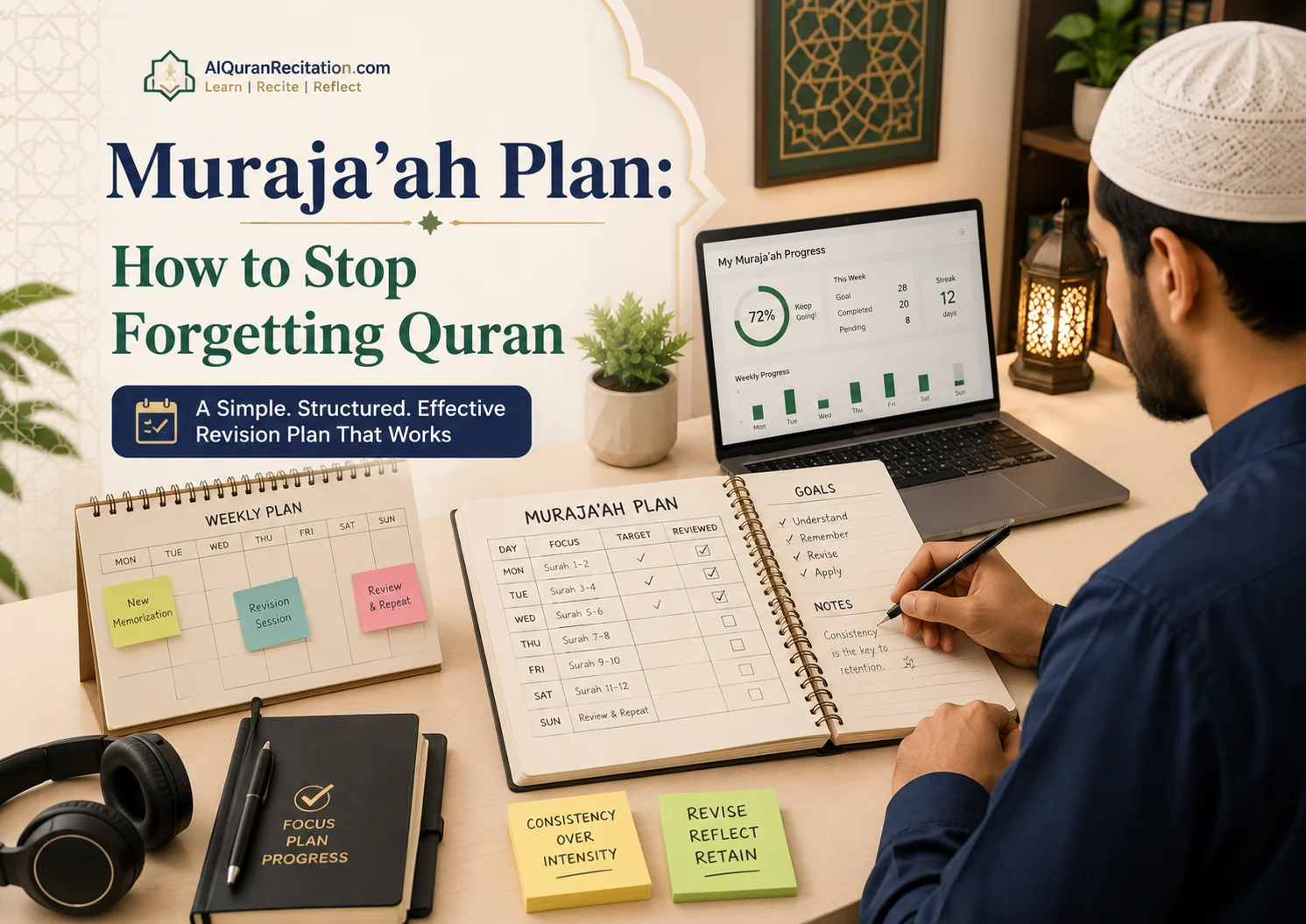
Muraja’ah Plan: How to Stop Forgetting Quran
“I memorized this Surah before. Why do I still need the Mushaf every few lines?”
That question hurts because the work was real. You sat with the page. You repeated it. You may have recited it well at one point. Then, after some time, the words feel far away. You remember the opening, then stop. You mix up similar endings. You recognize the page when you see it, but you cannot recite it from memory.
Many students try to solve this by memorizing more.
That usually does not fix the problem.
A strong Hifz routine needs daily Quran revision. This is Muraja’ah: returning to what you already memorized, testing it, correcting it, and keeping it active through steady review.
What Muraja’ah means in Quran memorization
Muraja’ah means revision. In Quran memorization, it means reviewing what you have already memorized until you can recite it without depending on the Mushaf.
It is not just reading the same page again.
A proper Quran revision plan includes:
- Reciting from memory
- Checking mistakes
- Repeating weak lines
- Reviewing old portions before they fade
- Testing yourself without looking
- Reciting to a teacher or listener when possible
The Prophet Muhammad ﷺ gave clear guidance about taking care of memorized Quran.
Arabic Hadith:
قال النبي ﷺ: «تَعَاهَدُوا الْقُرْآنَ، فَوَالَّذِي نَفْسِي بِيَدِهِ، لَهُوَ أَشَدُّ تَفَصِّيًا مِنَ الإِبِلِ فِي عُقُلِهَا»
English meaning:
The Prophet ﷺ said: “Commit yourselves to the Quran, for by Him in Whose Hand is my soul, it is more likely to escape than a camel from its tether.”
Source: Sahih al-Bukhari, Hadith 5033.
This Hadith does not teach panic. It teaches care. Quran memorization needs regular attention. A student should not treat old memorization as something finished forever.
Why students forget memorized Quran
Forgetting does not always mean the student is careless. Sometimes the first memorization was not firm enough. Sometimes revision was irregular. Sometimes the student moved forward before old portions were ready.
Before blaming yourself, look at the cause.
Skipping old revision
Many students revise only the newest lesson. Yesterday’s page gets attention. Last week’s page gets a little attention. Last month’s pages are left alone.
Then the pattern becomes clear:
- New pages feel strong
- Recent pages feel shaky
- Old pages collapse
A Hifz revision schedule must include old memorization. If you only review recent work, your Muraja’ah is incomplete.
Rushing new memorization
New memorization feels exciting. Revision often feels slow.
That is why students sometimes keep adding pages even when old pages are weak.
But one new page is not real progress if three old pages become weaker. A Quran memorization schedule should protect what you already have before it adds more.
Reviewing by reading only, not testing
Reading from the Mushaf helps, but it does not always prove memorization.
A student may read a page many times and feel confident. Then the Mushaf closes, and the page disappears.
Testing is different.
Testing means reciting from memory, then checking. It shows the real state of your Hifz.
Weak Tajweed or repeated mistakes
Some memorization becomes weak because the same pronunciation mistake, vowel mistake, or stopping mistake keeps coming back.
When the tongue learns the wrong pattern, revision becomes harder later.
This is where Tajweed correction matters. The aim is not to scare the student. The aim is to correct early before mistakes settle deeply.
First step: check what is strong, weak, and forgotten
Do not begin with a huge timetable.
Begin with an honest check.
Take the Surahs, pages, or Juz you have memorized. Divide them into three groups.
Strong portions
These are the parts you can recite without looking, with few mistakes, and without long pauses.
Strong does not mean you stop revising them. It means they need maintenance, not repair.
Shaky portions
These are the parts you partly remember, but you pause often. You may confuse similar verses, miss endings, or need the first word of the next line.
These portions need more attention than the strong ones.
Forgotten portions
These are the parts you cannot recite properly without looking. You may know you memorized them before, but they are not ready from memory now.
Treat them as repair work. Do not pretend they are still strong.
This check can feel uncomfortable, but it saves time. Many students struggle because they revise everything the same way. Strong pages, shaky pages, and forgotten pages do not need the same treatment.
A simple daily Quran revision plan
A good daily Quran revision routine must be realistic. If the plan is too heavy, you may follow it for a few days, then leave it.
Use four parts.
New memorization
If your old memorization is not falling apart, you may keep a small amount of new memorization.
For example:
- Five lines for a beginner
- Half a page for a steady student
- One page for a stronger student with teacher supervision
These are examples, not fixed rules. Some students need less. Some can handle more.
Recent revision
Recent revision means reviewing the pages you memorized in the last few days or weeks.
This matters because new Hifz is fragile.
A simple method:
- Revise yesterday’s lesson
- Revise the last three to seven lessons
- Recite them from memory before opening the Mushaf
- Mark the mistakes
If yesterday’s lesson is already weak, do not add more new memorization that day.
Old revision
Old revision protects what you memorized months or years ago.
This can be a fixed daily amount.
For example:
- One page daily for a beginner
- Two to four pages daily for a student with several Juz
- Half a Juz or more for an advanced student, if manageable
The amount depends on your level. The rule is simple: old memorization should appear in your week, not only in your memory of past effort.
Weak-point repair
Every student has weak spots.
Do not revise a full page again and again while ignoring the two lines that keep breaking.
Repair the exact weak point.
Use this method:
- Find the mistake
- Read the correct line carefully
- Repeat it from memory
- Connect it with the line before and after
- Test it again later the same day
This is slow, but it is better than vague repetition.
When to pause new Hifz
Some students need to stop new memorization for a short time.
This is not failure. It may be the right step.
Too many mistakes in old portions
If you cannot recite old pages without repeated help, revision needs priority.
Adding new pages while old ones are weak often creates more stress later.
Fear of testing
If you only revise alone because you fear being tested, that is a sign. You may be reading more than reciting.
Testing shows the truth. It also shows what to fix next.
Needing the Mushaf too often
There is no shame in checking the Mushaf. But if every few lines need help, that portion is not strong yet.
Pause. Repair. Then continue.
How to repair weak Surahs
Weak Surahs need focused work. Do not rush them.
Listen before reciting
Listen to a reliable reciter for the portion you are repairing. Pay attention to pronunciation, endings, pauses, and flow.
Listening does not replace reciting, but it can refresh the pattern in your ear.
Recite aloud from memory
Silent revision can hide mistakes.
Recite aloud. Your tongue, ear, and memory need to work together.
If possible, record yourself. Then compare with the Mushaf or ask a teacher to listen.
Mark mistakes
Do not only say, “This page is weak.”
Mark the exact problem:
- Wrong vowel
- Missing word
- Confused ending
- Wrong starting point
- Weak connection between two lines
This turns a vague problem into a clear task.
Repeat only the weak lines
If one line is weak, do not repeat the full page ten times and hope the line fixes itself.
Repeat the weak line. Then connect it with what comes before and after.
For example:
- Repeat the weak line five times while looking
- Repeat it five times from memory
- Recite the line before it, the weak line, and the line after it
- Test it again after a short break
This kind of Quran memorization revision is more useful than random repetition.
Muraja’ah plan for children
Children forget quickly when revision is too long, too tense, or too irregular.
A child may memorize a short Surah well, then lose it because nobody reviews it for several weeks.
For children, keep Muraja’ah short and steady.
Keep sessions short
A child does not need a heavy review session every day.
Start with small targets:
- One short Surah
- A few lines
- One old lesson
- One mistake correction
Small daily review is often better than one long, stressful session each week.
Use Salah and listening
Short Surahs can be reviewed through daily prayer, listening, and gentle testing.
Parents can ask the child to recite one Surah before sleep or after a lesson. Keep the tone calm. The aim is care, not pressure.
Avoid shame and pressure
Do not say, “You forgot again?”
That can make a child afraid to recite.
Say something more useful:
“This part is weak. We will fix it slowly.”
A parent’s tone can decide whether Muraja’ah becomes a habit or a source of fear.
When a Quran teacher can help
Some students can revise alone for a while. Many students, though, need a teacher, especially when mistakes keep returning.
A teacher can help with three things.
Tajweed correction
A student may not hear their own mistakes. A teacher can catch issues in letters, vowels, lengthening, stopping, and joining.
If Tajweed errors keep repeating during Muraja’ah, structured online Quran classes may help the student revise with better feedback.
Accountability
Many students revise better when someone listens to them.
A teacher can test old portions, track weak pages, and stop the student from rushing forward too soon.
A realistic Hifz revision schedule
A good Hifz revision schedule should match the student’s level. A child, a busy parent, a beginner, and an advanced Hifz student do not need the same plan.
If your memorization keeps breaking, teacher support through Quran memorization online can help you review weak portions, correct mistakes, and build consistency. This does not guarantee retention. It gives you structure, feedback, and a clearer path.
For children, online Quran classes for kids can support revision with shorter lessons, teacher listening, and age-appropriate correction. Beginners who still struggle with reading foundations may also need Noorani Qaida online before their memorization routine becomes stable.
Common Muraja’ah mistakes to avoid
Many students are not struggling because they lack ability. They are using a weak system.
Avoid these mistakes:
- Only revising the newest lesson
- Adding new memorization while old pages are collapsing
- Reading from the Mushaf but not testing from memory
- Repeating full pages while ignoring exact weak lines
- Changing plans every few days
- Revising only when motivated
- Avoiding teacher correction
- Comparing your pace with another student
A useful Quran revision program is not always the heaviest one. It is the one you can follow, measure, and adjust.
Final advice for a realistic revision routine
If you keep forgetting Quran, do not begin by blaming your memory.
Ask better questions:
- Do I revise old portions every week?
- Do I test myself without looking?
- Do I know exactly where my weak lines are?
- Am I adding new Hifz too quickly?
- Do I need someone to listen to me?
Muraja’ah is not a side task after memorization. It is part of memorization.
Start with a small daily Quran revision plan. Check what is strong, weak, and forgotten. Repair weak parts before chasing new pages. Get teacher feedback when mistakes keep returning.
Steady revision may feel slow at first, but it protects your effort better than rushing.
Related resources
- online Quran classes
- online Quran classes for kids
- Quran memorization online
- Noorani Qaida online
- online Quran recitation classes
- Quran Tajweed course
- Quran memorization courses
Frequently Asked Questions
What is Muraja’ah?
Muraja’ah means revising previously memorized Quran. It includes reciting from memory, checking mistakes, repeating weak parts, and keeping old memorization active.
How much Quran should I revise daily?
The amount depends on your level. A beginner may revise a few lines or one page. A stronger student may revise several pages. The key is consistency and accurate recitation.
Why do I keep forgetting Quran after memorizing it?
Common causes include weak original memorization, irregular revision, rushing new Hifz, reviewing only by reading, and not correcting repeated mistakes.
Should I stop new memorization if my old Hifz is weak?
In many cases, yes, at least for a short time. Repairing weak memorization before adding more can protect your progress.
How do I revise a Surah I forgot?
Listen to the Surah, read it carefully, recite aloud from memory, mark mistakes, repeat weak lines, and connect each weak line with the lines before and after it.
Can I do Muraja’ah without a teacher?
Some revision can be done alone, but a teacher can help catch mistakes, test old portions, correct Tajweed, and build a realistic review schedule.
Are online Quran classes useful for Muraja’ah?
Online Quran classes may help students who need structure, teacher listening, Tajweed correction, and accountability. They do not guarantee memorization.
Share this article
Start Your Quran Journey Today
Book 2 FREE trial lessons with a certified teacher — no credit card required.
Book 2 FREE Trial Lessons