Quran Learning
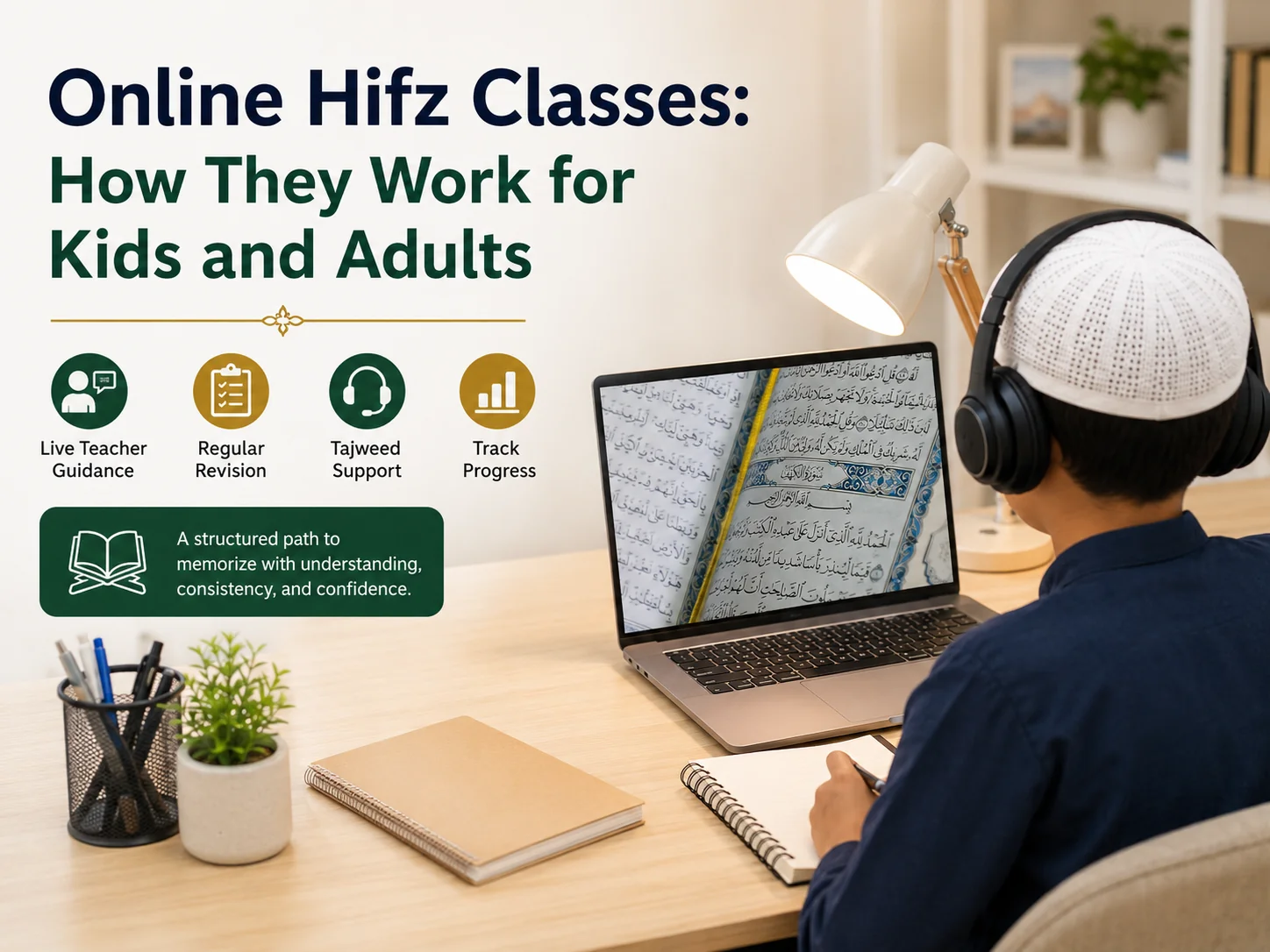
Online Hifz Classes: How They Work for Kids and Adults
Online Hifz classes can support children and adults with Quran memorization through teacher correction, revision, Tajweed support, and a steady learning plan.
Online Hifz Classes: How They Work for Kids and Adults
Many parents ask this before starting Hifz online: will my child really memorize correctly through a screen?
Adults ask a different version of the same question: can I memorize while working, studying, or raising a family?
Both questions are fair. Hifz is not just repeating new lines until they sound familiar. A serious memorization plan needs listening, correction, revision, Tajweed care, and steady follow-up. Online Hifz classes can support that when they are structured well and when the student is not pushed faster than they can retain.
What Are Online Hifz Classes?
Online Hifz classes are live Quran memorization lessons taught through an online classroom. The teacher listens to the student, corrects mistakes, assigns new memorization, reviews older portions, and follows progress over time.
Hifz means memorization. In this context, it refers to memorizing the Quran with care and regular revision. It should not be treated as a race to finish pages.
- The teacher listens to the student’s recitation.
- The student receives a suitable memorization task.
- Recent memorization is reviewed.
- Older memorization is checked.
- Mistakes are corrected before they become habits.
A good online Hifz class should not depend only on the student reading alone at home. The teacher should hear the recitation, correct pronunciation, test retention, and adjust the pace when needed.
How Online Hifz Classes Work
Most online Hifz classes include three main parts: new memorization, recent revision, and older revision. Some teachers use Arabic terms such as Sabaq, Sabqi, and Manzil. The wording may differ, but the idea is simple.
New memorization gives the student a fresh portion to learn. Recent revision checks what was memorized in the last few days or weeks. Older revision returns to earlier surahs, pages, or juz so they do not become weak.
This structure helps the teacher see the real state of the student’s memorization. A student may recite today’s lesson well but still struggle with last week’s portion. That is why revision must be part of the class, not something left for later.
How Hifz Classes Work for Kids
Shorter Lessons and Clear Targets
Children need a different Hifz plan from adults. Some children memorize quickly, but they may also forget quickly when revision is weak. They need attention, repetition, encouragement, and supervision.
A child’s Hifz class should suit their age and attention span. A young child may need a shorter session, more repetition, and a clear daily target. The teacher should not overload the child because the family wants fast progress.
What a Child’s Lesson May Include
A useful child lesson may begin with yesterday’s memorization. The teacher can then correct repeated pronunciation mistakes, read the new portion with the child, and ask for careful repetition.
The class may end with a short home revision task. This simple structure works better than giving a child too much new memorization without checking retention.
Parent Support Between Classes
Parents do not need to become Quran teachers. But they do need to help with routine.
A parent can check whether the child reviewed the assigned portion, attended class on time, kept distractions away, and followed the teacher’s revision plan. For younger children, this support can make a clear difference.
When the Pace May Be Too Heavy
If a parent notices that the child is crying, avoiding class, forgetting often, or rushing through recitation, the pace may need adjustment.
Hifz should be serious, but children should not be pressured in a way that harms their relationship with learning Quran.
Why Online Supervision Can Help
For many families, online Quran classes for kids are useful because parents can stay nearby and understand what the teacher is assigning.
This helps the child continue correctly after class. It also helps parents notice when the child needs more revision, a slower pace, or extra reading practice.
When Reading Should Come First
Some children begin Hifz after they can already read Quran fluently. Others may need Noorani Qaida online or basic recitation lessons first.
That is not a delay. It can protect the child from building memorization on weak reading.
What Parents Should Ask the Teacher
Parents should ask how much new memorization is suitable, how revision will be checked, and what should be done between classes.
They should also ask how repeated mistakes will be corrected. A clear answer here is more useful than a promise of fast progress.
How Hifz Classes Work for Adults
Adults often begin Hifz with a private worry: “Is it too late for me?”
Flexible Scheduling
Adults need a realistic plan. Work, family, study, tiredness, and weak reading can all affect pace.
A good teacher should build the plan around the adult’s real schedule, not around an ideal day that does not exist. Some adults study early in the morning. Others study after work or after their children sleep.
Realistic Pacing
Adults may memorize selected surahs, one juz, several juz, or work toward full Hifz over time. Not every adult has the same goal, and not every goal needs the same schedule.
The main point is consistency. A small daily memorization target with steady revision is usually better than intense effort for one week followed by long breaks.
Partial Hifz and Selected Surahs
Some adults cannot commit to full Hifz at the start. They may begin with selected surahs, Juz Amma, Juz Tabarak, or the portions they recite most often.
This can still be a valuable learning path. The goal should be accuracy, retention, and regular review, not comparison with another student.
Why Revision Matters More Than Speed
The biggest mistake in Hifz is chasing new pages while old pages become weak.
- New memorization may feel like progress.
- Recent revision shows whether the new portion is becoming stable.
- Older revision protects what was memorized before.
- Daily Quran revision helps prevent weak retention.
- A slower pace may be better when mistakes keep repeating.
A balanced Quran memorization schedule should include both new memorization and daily Quran revision. If a student only prepares new lessons for the teacher, the memorization may not stay strong.
The Role of Tajweed in Hifz
Tajweed Should Not Be Ignored
Hifz should not ignore Tajweed. If a student memorizes with repeated pronunciation mistakes, those mistakes can become harder to correct later.
This does not mean every beginner must study advanced Tajweed before memorizing anything. It means the teacher should correct the student’s recitation according to the student’s level.
When Tajweed Support Is Needed
Some students need a separate Quran Tajweed course before starting a serious Hifz plan.
Others can work on Tajweed correction while memorizing small portions. The right choice depends on the student’s current reading and pronunciation.
When Basic Reading Comes First
If a student cannot read Arabic letters correctly, struggles with vowel sounds, or guesses words from memory, Hifz may become unstable.
In this case, it may be better to begin with basic Quran reading first. This is common for children and non-Arabic speakers.
Why Correction Should Be Early
Early correction is easier than repairing the same mistake after months of repetition.
A teacher should not ignore repeated errors just to keep the student moving forward. Correct recitation and steady memorization should grow together.
How Wider Quran Study Can Help
Some learners are ready for Hifz. Others first need recitation, Tajweed, Arabic reading, or Noorani Qaida.
Families looking for wider Quran study can explore online Quran classes before choosing a Hifz-only route.
Online Hifz vs In-Person Hifz
Online Hifz is not automatically better than in-person Hifz. In-person learning can offer a stronger classroom environment, peer motivation, and fewer screen distractions for some students.
Online Hifz may suit families who need flexible timing, one-to-one attention, access to teachers outside their area, or parent visibility during children’s lessons.
The better choice depends on the student. A child who needs group motivation may benefit from in-person learning. A shy student may do better one-to-one online. An adult with limited travel time may find online lessons easier to keep.
Useful Learning Links
- online Quran classes
- online Quran classes for kids
- Quran memorization online
- online Quran recitation classes
- Quran Tajweed course
- Quran memorization courses
How to Choose the Right Online Hifz Program
Ask About the Teacher
Ask whether the teacher has strong Quran memorization, Tajweed knowledge, and experience teaching the student’s age group. If Ijazah or formal training is mentioned, ask what it covers.
Ask About the Class Structure
A serious Hifz class should not only assign new memorization. Ask how the teacher balances new lesson, recent revision, old revision, Tajweed correction, testing, and home assignments.
Ask About Schedule Fit
The best schedule is not the heaviest schedule. It is the schedule the student can keep.
Ask About Starting Level
Some students are ready for Hifz. Others need recitation, Tajweed, Arabic reading, or Noorani Qaida first. A careful teacher should check the level before assigning a memorization plan.
Ask About Parent Communication
For children, parents should know what was assigned, what needs revision, and whether the child is struggling. This helps the family support the class without guessing.
A Careful Way to Start
At AlQuranRecitation.com, students can study Quran memorization online with teacher-led support. Some students may begin directly with Hifz. Others may first need Quran reading, Tajweed correction, Arabic basics, or Noorani Qaida. The right starting point depends on the student’s level, age, and schedule.
Before choosing any Hifz class, ask one honest question: will this plan help the student remember correctly after the lesson is over?
شارك المقالة