Quran Learning
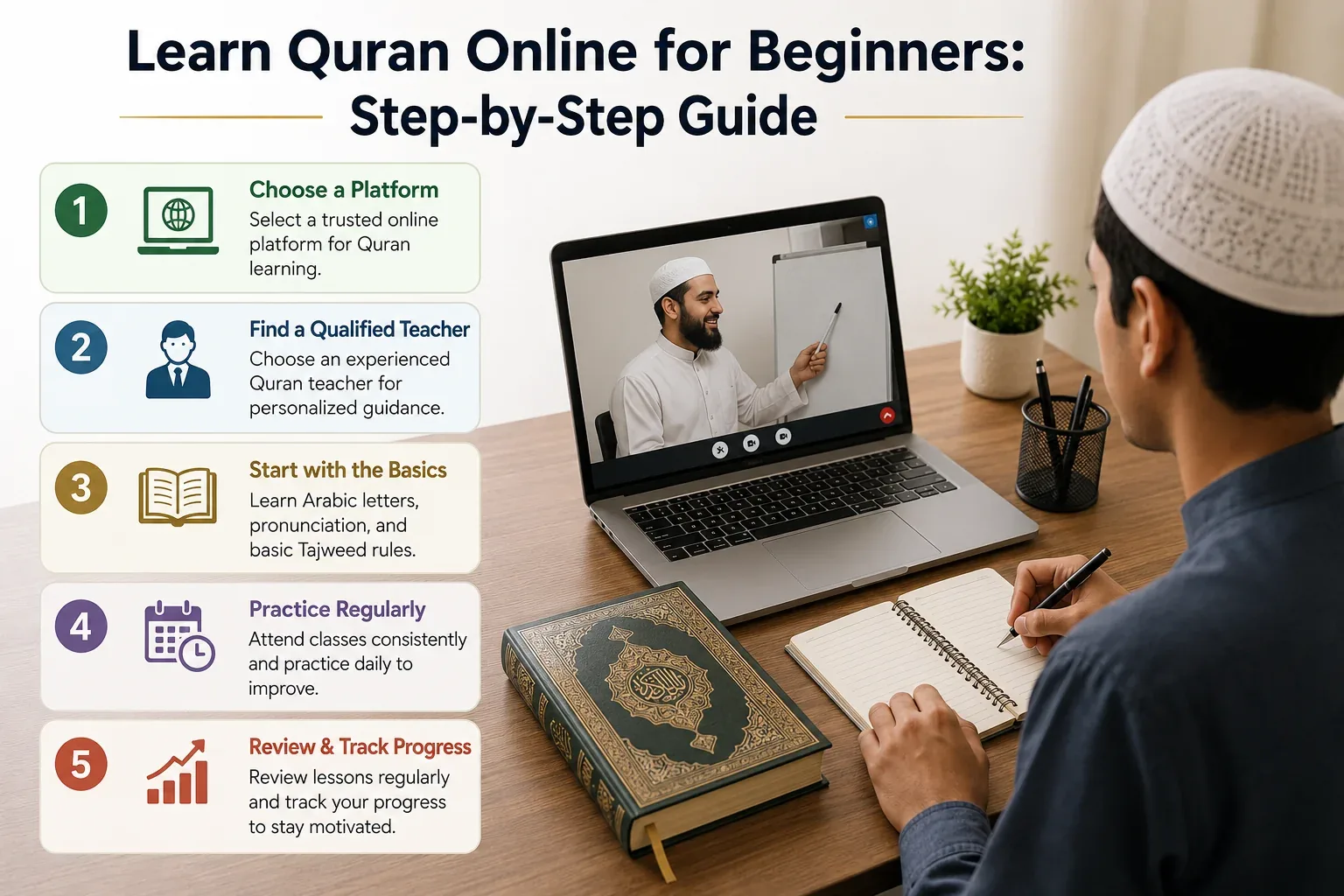
Learn Quran Online for Beginners: Step-by-Step Guide
A clear beginner guide for learning Quran online step by step, starting with Arabic letters, Noorani Qaida, slow Quran reading, basic Tajweed, and teacher correction.
Learn Quran Online for Beginners: Step-by-Step Guide
You want to learn Quran online, but the first step is not clear.
Do you begin with Arabic letters? Do you join a Tajweed class? Do you memorize short Surahs first? Or do you start with Noorani Qaida?
This confusion is common, especially for adults, parents, and non-Arabic speakers. Many beginners rush into reading from the Mushaf before they can recognize letters, vowels, and joined words with confidence.
A steadier path works better. Learn the letters. Practice the sounds. Build word reading. Read slowly. Get correction. Add Tajweed step by step.
Table of Contents
- Why Beginners Need a Clear Quran Learning Path
- Step 1: Start with Arabic Letters and Sounds
- Step 2: Build the Foundation with Noorani Qaida
- Step 3: Begin Quran Reading Slowly
- Step 4: Learn Basic Tajweed Rules Gradually
- Step 5: Learn with a Quran Teacher Online
- Common Mistakes Beginners Should Avoid
- How to Choose the Right Online Quran Class
Why Beginners Need a Clear Quran Learning Path
A beginner does not need a complicated plan. A beginner needs the right order.
Quran reading is not only about recognizing Arabic letters on a page. A student also needs to know how letters change shape, how vowels affect sound, how letters join, and how pronunciation should be corrected.
That is why the beginner stage should not feel rushed. It should feel clear.
A careful path usually looks like this:
- Learn the Arabic letters.
- Practice the sounds of each letter.
- Learn vowels and simple signs.
- Practice joining letters into words.
- Read short words and short phrases.
- Move slowly into Quran reading.
- Add basic Tajweed rules with teacher correction.
This order helps the student avoid weak habits. When the foundation is rushed, mistakes can become harder to fix later.
Step 1: Start with Arabic Letters and Sounds
The first step is not reading long verses. The first step is knowing the letters.
A beginner should learn the Arabic alphabet for Quran reading with care. This means more than naming the letters. The student should hear the sound, repeat it, and learn how the letter appears at the start, middle, and end of a word.
Learn the Arabic alphabet for Quran reading
Arabic letters change shape depending on where they appear. A letter may look different when it stands alone and when it joins another letter.
A beginner needs time with this before reading full Quranic words.
A teacher may ask the student to read one row of letters many times. That can feel slow, but it is useful. Slow work at this stage often saves time later.
Focus on Quran letters pronunciation
Some Arabic letters may sound close to each other for non-Arabic speakers. A beginner may confuse similar sounds if no one corrects them.
For example, a student may struggle with letters that come from the throat, tongue, or deeper mouth positions. This is normal. The answer is correction and repetition, not embarrassment.
Good Quran letters pronunciation begins with listening, repeating, and receiving feedback.
Do not rush into long verses
Many beginners want to read from the Mushaf immediately. That desire is understandable.
But reading too early can create mistakes that were avoidable.
A student who cannot identify vowels, Sukoon, Tanween, or joined letters may start guessing words instead of reading them. Guessing is not a strong learning method. The student needs the foundation first.
Step 2: Build the Foundation with Noorani Qaida
Many beginners use Noorani Qaida online before reading directly from the Mushaf. It gives the student a step-by-step path from letters to words.
This can help adults, children, and non-Arabic speakers when it is taught slowly and with correction.
What Noorani Qaida teaches beginners
Noorani Qaida usually teaches:
- Arabic letters
- letter shapes
- short vowels
- long vowels
- Sukoon
- Tanween
- Shaddah
- joining letters
- reading simple words
These skills prepare the student for Quran reading for beginners.
The goal is not to finish the book quickly. The goal is to read with better control.
How it helps with vowels and joining letters
Many reading mistakes come from weak vowel recognition.
A beginner may know a letter but misread the sound because the vowel is not clear. Another student may recognize separate letters but struggle when the letters are joined.
Noorani Qaida gives the student controlled practice before moving into longer Quranic text.
When to move from Qaida to Mushaf reading
A student may be ready to move forward when they can:
- recognize letters quickly
- read basic joined words
- understand simple vowel signs
- read aloud without guessing every word
- accept correction and repeat calmly
Some students reach this stage quickly. Others need more time. Both are normal.
Step 3: Begin Quran Reading Slowly
After the foundation, the student can begin Quran reading in a controlled way.
This does not mean reading large portions alone. It means reading short sections with guidance.
Start with short words and short Surahs
A beginner may begin with short words, then short phrases, then short Surahs.
The teacher should not only listen for whether the student finishes the line. The teacher should listen for letter sounds, vowels, pauses, and repeated mistakes.
This is where live reading practice can help, especially when the teacher gives direct correction. Students can also compare course approaches by reviewing external examples of online Quran recitation classes.
Read aloud with correction
Silent reading is not enough for beginners.
The student needs to read aloud. The teacher needs to hear the sound. Without this, pronunciation mistakes may stay hidden.
A student may recognize a letter on the page and still pronounce it incorrectly. That is why live feedback matters.
Use listening as support, not as a replacement
Listening to careful recitation can help a beginner hear rhythm, pauses, and pronunciation.
But listening alone does not prove that the student can read correctly.
A beginner may repeat what they hear without understanding the letters and signs. Listening can build familiarity, but it does not replace reading practice with correction.
Step 4: Learn Basic Tajweed Rules Gradually
Tajweed should not be pushed onto the beginner all at once.
It should also not be ignored.
A balanced teacher introduces Tajweed rules for beginners in small steps, after the student has enough reading ability to apply them.
What Tajweed means for beginners
For a beginner, Tajweed starts with reading more carefully.
This may include:
- giving letters their correct sound
- not swallowing vowels
- stretching sounds where needed
- stopping at suitable places
- not rushing through words
The student does not need advanced terms on day one. The student needs correct practice.
Which basic rules may come first
A teacher may begin with simple rules linked to the student’s reading level.
For example:
- clear pronunciation of letters
- basic Madd practice
- Sukoon and Shaddah practice
- simple stopping and starting
- common beginner mistakes in short Surahs
The exact order may differ by teacher and student.
Why Tajweed should be taught with practice
Tajweed is not learned well by reading rules only.
A beginner needs to apply each rule during recitation. The teacher explains, listens, corrects, and asks the student to repeat.
This is a safer way to learn Quran online with Tajweed. One rule at a time. One sound at a time. One lesson at a time.
For extra comparison, students can look at how a structured Quran Tajweed course presents Tajweed learning and correction.
Step 5: Learn with a Quran Teacher Online
A beginner can watch videos and use apps. These tools may help with review.
But a beginner still needs correction from a teacher, especially for pronunciation and Tajweed.
What a good beginner lesson should include
A useful beginner lesson should include:
- review from the previous lesson
- new letters, sounds, or words
- reading aloud
- teacher correction
- short practice tasks
- clear homework
The teacher should not move too fast just to complete pages.
A beginner lesson should feel structured, not random.
Why one-on-one correction can help
One-on-one Quran classes can help beginners because the teacher hears the student clearly.
If the student struggles with one letter, the teacher can stop and correct it. If the student reads too fast, the teacher can slow the pace. If the student is shy, the teacher can build confidence through repetition.
This does not mean group classes never work. It means beginners often need personal attention, especially at the start.
What to ask before joining online Quran classes
Before joining online Quran classes, ask practical questions:
- Does the course start from Arabic letters?
- Is Noorani Qaida included if needed?
- Will the teacher correct pronunciation during class?
- How often will the student read aloud?
- Is basic Tajweed included gradually?
- Can adults start from zero?
- Can parents receive feedback for children?
Good answers should be clear. Vague promises are not enough.
Who Can Use This Beginner Path?
This path can work for different learners, but the pace should change.
Adults starting from zero
Adults may feel embarrassed when they start late. They should not.
An adult beginner often has better focus than a child, but may need more time with pronunciation if they have never studied Arabic sounds before.
The teacher should be patient and direct.
Children learning with parent support
Children need shorter lessons, repetition, and parent follow-up.
A parent does not need to be a Quran teacher to help. Simple support can make a difference.
For example, the parent can help the child revise yesterday’s letters, attend the first few minutes of class, or check that homework is completed.
Families looking for online Quran classes for kids should ask how the teacher handles attention, revision, and feedback.
Non-Arabic speakers
Non-Arabic speakers can begin, but they need a slower start with sounds and letter positions.
The teacher should not assume the student already understands Arabic pronunciation.
Clear correction matters more than speed.
Common Mistakes Beginners Should Avoid
Most beginner problems do not come from lack of effort. They come from the wrong method.
Skipping the letters
Some students want to start from Surahs only. This may help them repeat sounds, but it does not build independent reading.
If the student wants to read from the Mushaf, letters and vowels must come first.
Learning only from videos
Videos can support review. They cannot hear you.
A beginner needs someone to listen, correct, and explain the mistake.
Starting memorization too early
Quran memorization is a serious goal. It should not be rushed before the student can read with enough accuracy.
Some students may memorize short Surahs while learning to read. That can be fine with teacher guidance. But memorization should not replace reading foundations.
Students who are ready later can move into Quran memorization online with a more structured plan. Families may also compare external examples of Quran memorization courses before choosing a learning path.
Changing teachers too often
Beginners need stability.
If the teacher changes every few lessons, the student may receive different methods and mixed correction. A stable plan is usually better.
Expecting quick results
A beginner may improve in weeks, but Quran reading takes steady work.
Progress depends on the student’s age, starting level, lesson frequency, practice, and teacher feedback.
Fast promises should not guide the learning plan.
Simple Weekly Practice Plan for Beginners
A beginner does not need long daily sessions at first.
Short, regular practice can work better than one long session once a week.
A simple weekly plan may look like this:
- Review old letters or words for five minutes.
- Practice the new lesson from Noorani Qaida or the teacher’s material.
- Read aloud, not silently.
- Repeat corrected words three to five times.
- Listen to careful recitation for support.
- Keep one notebook for repeated mistakes.
For children, the practice may be shorter. For adults, the practice may be more focused. The plan should match the learner.
How to Choose the Right Online Quran Class
A beginner Quran class should not only sound impressive. It should answer the student’s real need.
If the student cannot read Arabic, the class should not start with long Quran passages. It should start with letters, pronunciation, vowels, and Noorani Qaida when needed.
Look for teacher correction.
A beginner should not spend the whole lesson listening. The student must read aloud and receive feedback.
Look for gradual Tajweed.
A good teacher does not overload the student with rules. The teacher introduces Tajweed through practice.
Look for clear review.
Beginners forget. Review is not a waste of time. It is part of learning.
If you are starting from zero, Al Quran Recitation Academy can support you with beginner-friendly Quran reading, teacher feedback, Tajweed correction, Arabic understanding, and steady practice. Choose the starting point that matches your current level, then move forward step by step.
Frequently Asked Questions
Can I learn Quran online as a complete beginner?
Yes, a complete beginner can learn Quran online if the course starts from the right level. The student may need Arabic letters, pronunciation practice, Noorani Qaida, and teacher correction before reading longer Quran passages.
What should I learn first before reading the Quran?
Start with Arabic letters, letter sounds, vowels, and joined letters. Many beginners use Noorani Qaida before reading directly from the Mushaf.
Do I need to know Arabic before starting Quran reading?
You do not need to speak Arabic before starting. But you do need to learn Arabic letters and sounds for Quran reading.
When should beginners start learning Tajweed?
Beginners can start basic Tajweed gradually after they can recognize letters, vowels, and simple words. Tajweed should be taught with practice and correction.
Can adults learn Quran online from zero?
Yes. Adults can begin from zero. They may need patience with pronunciation and regular practice, but starting late should not stop them.
Are online Quran classes suitable for children?
Online Quran classes can suit children when the lesson is age-appropriate, structured, and supported by parent follow-up. Shorter lessons and regular revision often help children more than long sessions.
Can I learn Quran only from videos or apps?
Videos and apps may help with review, listening, and practice. They should not replace teacher correction, especially for pronunciation and Tajweed.
How often should a beginner practice Quran reading?
Short, regular practice is usually better than rare long sessions. The right schedule depends on the student’s age, level, and lesson plan.
Frequently Asked Questions
Can I learn Quran online as a complete beginner?
Yes, a complete beginner can learn Quran online if the course starts from the right level. The student may need Arabic letters, pronunciation practice, Noorani Qaida, and teacher correction before reading longer Quran passages.
What should I learn first before reading the Quran?
Start with Arabic letters, letter sounds, vowels, and joined letters. Many beginners use Noorani Qaida before reading directly from the Mushaf.
Do I need to know Arabic before starting Quran reading?
You do not need to speak Arabic before starting. But you do need to learn Arabic letters and sounds for Quran reading.
When should beginners start learning Tajweed?
Beginners can start basic Tajweed gradually after they can recognize letters, vowels, and simple words. Tajweed should be taught with practice and correction.
Can adults learn Quran online from zero?
Yes. Adults can begin from zero. They may need patience with pronunciation and regular practice, but starting late should not stop them.
Are online Quran classes suitable for children?
Online Quran classes can suit children when the lesson is age-appropriate, structured, and supported by parent follow-up. Shorter lessons and regular revision often help children more than long sessions.
Can I learn Quran only from videos or apps?
Videos and apps may help with review, listening, and practice. They should not replace teacher correction, especially for pronunciation and Tajweed.
How often should a beginner practice Quran reading?
Short, regular practice is usually better than rare long sessions. The right schedule depends on the student’s age, level, and lesson plan.
Share this article
Start Your Quran Journey Today
Book 2 FREE trial lessons with a certified teacher — no credit card required.
Book 2 FREE Trial Lessons