Quran Tajweed
Quran Pronunciation Rules for Beginners
Learn the main Quran pronunciation rules beginners should understand, including Makharij, Sifaat, short vowels, Madd, Ghunnah, Qalqalah, and common pronunciation mistakes.
Quran Pronunciation Rules for Beginners
Many beginners are not careless. They are just hearing Arabic sounds that their ears are not trained to separate yet.
A student may read ح like ه, or ق like ك. The mouth changes only a little, but the sound changes. Sometimes the meaning may change too. This is why Quran pronunciation rules matter from the first lessons.
A beginner does not need to learn every advanced Tajweed detail at once. A better start is simpler: learn the letters, the vowels, where the sounds come from, and the basic rules that prevent common mistakes.
What Quran Pronunciation Rules Mean
Quran pronunciation rules help a learner pronounce Quranic Arabic letters and sounds correctly. They cover how each letter comes out, how vowels are read, when a sound is stretched, when a nasal sound appears, and how to stop at the end of words.
These rules are part of Tajweed. Tajweed is broader than pronunciation. It also includes elongation, merging, clarity, nasal sounds, and stopping rules.
For a beginner, the first goal is not to collect terms. The first goal is to hear the sounds properly and train the mouth to produce them with care.
Quran Pronunciation and Tajweed
Some students ask, “Are Quran pronunciation rules the same as Tajweed rules?”
Not exactly.
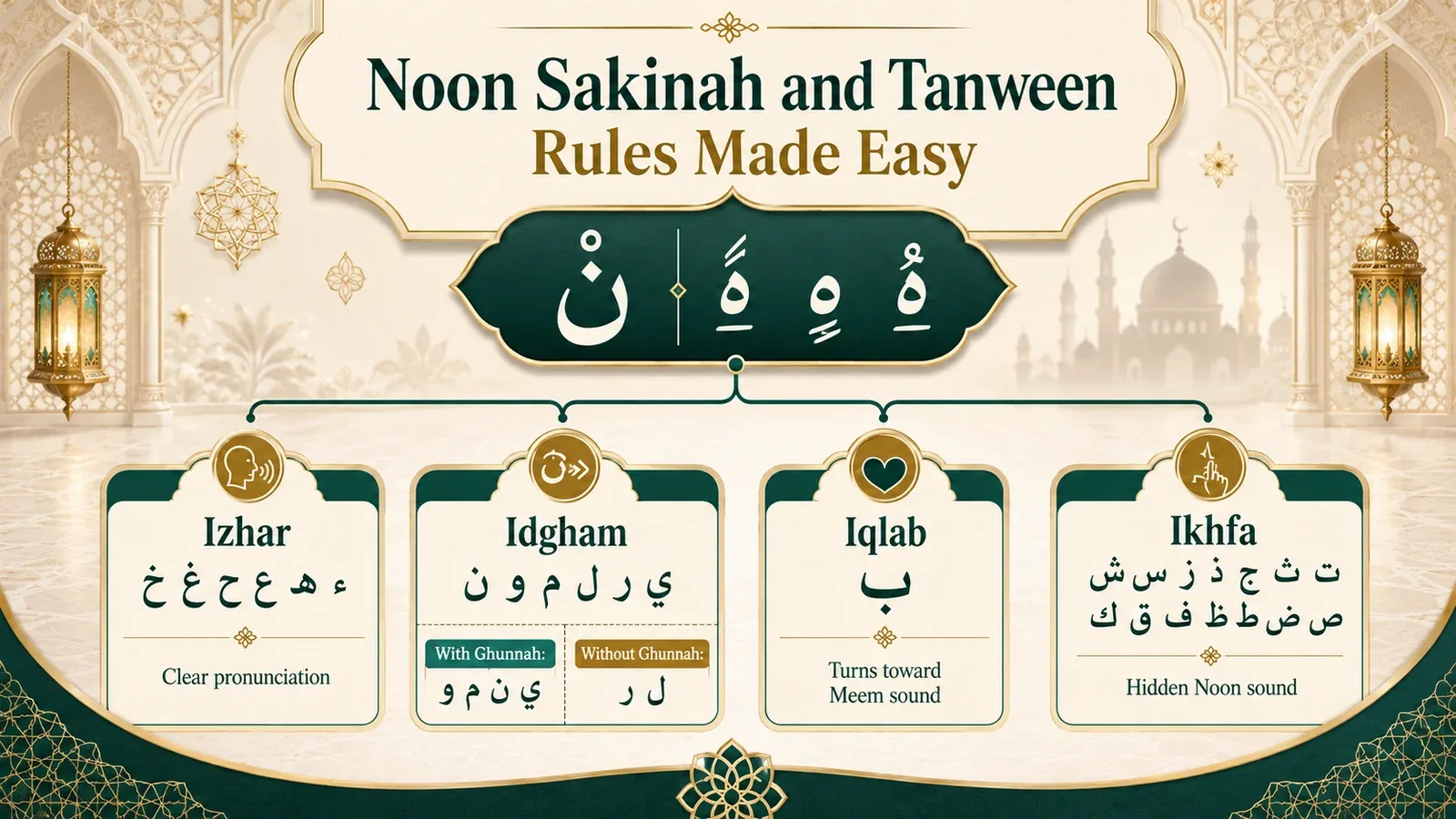
Pronunciation is about giving each letter and vowel its correct sound. Tajweed includes pronunciation, but it also covers rules such as Madd, Ghunnah, Qalqalah, Noon Sakinah, Meem Sakinah, and stopping.
A beginner should learn Tajweed step by step. Start with the sounds that affect daily reading. Learn the rule names after your mouth and ear begin to recognize them.
Why Correct Pronunciation Matters
The Qur’an is recited in Arabic. Arabic letters do not always match English sounds. Some letters come from the throat. Some come from the tongue. Some use the lips. Some are heavy. Some are light.
When a learner changes one letter into another, the meaning may change. This does not mean every beginner mistake has the same weight. It means the learner should take correction seriously and avoid becoming casual with the words of the Qur’an.
Allah says:
أَوْ زِدْ عَلَيْهِ وَرَتِّلِ الْقُرْآنَ تَرْتِيلًا
“Or add to it, and recite the Qur’an with measured recitation.”
Surah Al-Muzzammil, Surah 73, Verse 4
Teachers often mention this verse when they speak about careful recitation. A beginner should understand the lesson with balance. The aim is not panic. The aim is slow, careful, corrected reading.
The Safe Beginner Mindset
Do not chase speed.
Do not hide mistakes.
Do not rely only on transliteration.
Read slowly. Listen closely. Repeat the sound until your teacher can hear improvement. This is better than reading many pages while carrying the same mistake forward.
Main Rules Beginners Should Learn
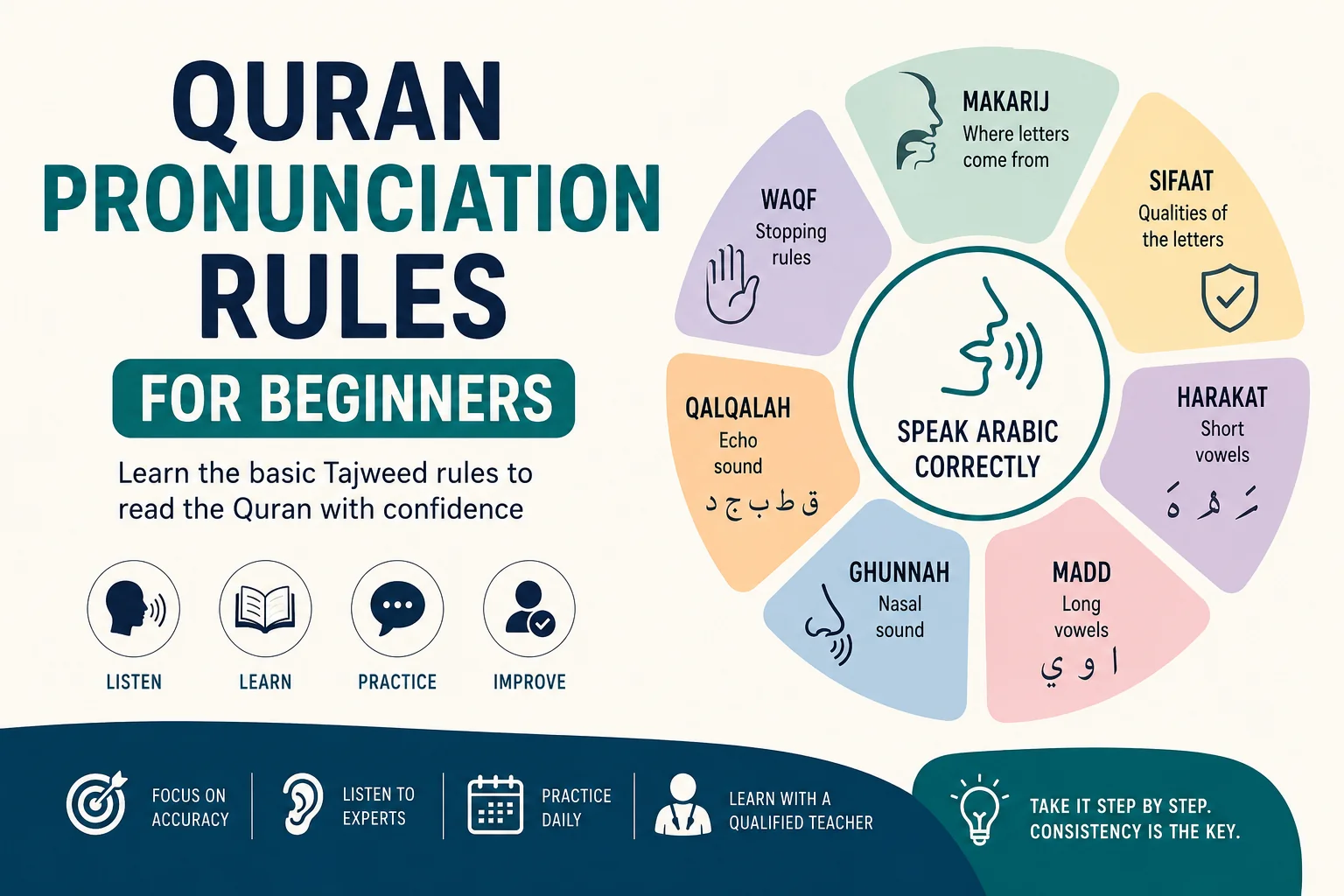
These Quran pronunciation rules give beginners a useful base. They are not the whole science of Tajweed, but they cover the areas where new learners usually need the most correction.
Makharij: Where Letters Come From
Makharij means the articulation points of letters. Put simply, it means where the sound comes from.
Some Quran letters come from the throat, such as ء, ه, ع, ح, غ, and خ. Some come from the tongue. Some come from the lips. The nasal passage is used for Ghunnah.
That is why a teacher may ask a student to repeat one letter many times before reading full words. The letter needs to come from the right place first.
Sifaat: Letter Qualities
Sifaat means the qualities of letters. Two letters may come from close places, but their qualities make them sound different.
For beginners, the most useful idea is heavy and light letters. For example, ص is heavier than س. ط is heavier than ت. If a learner makes every letter light, an important part of Quranic Arabic pronunciation is lost.
Do not try to memorize every Sifah at the start. First, learn how the letter should sound from a qualified teacher or reliable reciter.
Harakat: Short Vowels
Arabic short vowels are called Harakat.
- Fathah gives a short “a” sound.
- Kasrah gives a short “i” sound.
- Dammah gives a short “u” sound.
Many beginners make short vowels too long. A short vowel should stay short. If the sound is stretched without a reason, the rhythm and sometimes the meaning may be affected.
Sukoon and Shaddah
Sukoon means the letter has no vowel. The reader stops the vowel sound on that letter.
Shaddah means the letter is doubled. The first part is held, and the second part is read with its vowel.
Beginners often miss Shaddah because they read too quickly. This can weaken the word. When you see Shaddah, slow down and give the letter its proper weight.
Madd: Long Vowels
Madd means elongation. It happens when a sound must be stretched.
The basic Madd letters are:
- ا
- و
- ي
For beginners, the first step is simple: learn the natural long vowel before studying advanced Madd categories.
A common mistake is making long vowels short. Another mistake is stretching every vowel. Both need correction.
Ghunnah: Nasal Sound
Ghunnah is a nasal sound. It comes through the nose and appears in specific Noon and Meem rules.
You can understand the idea by saying an “n” or “m” sound and noticing the vibration in the nose. In Quran recitation, Ghunnah must be learned by listening. Written explanations help, but the sound itself needs practice.
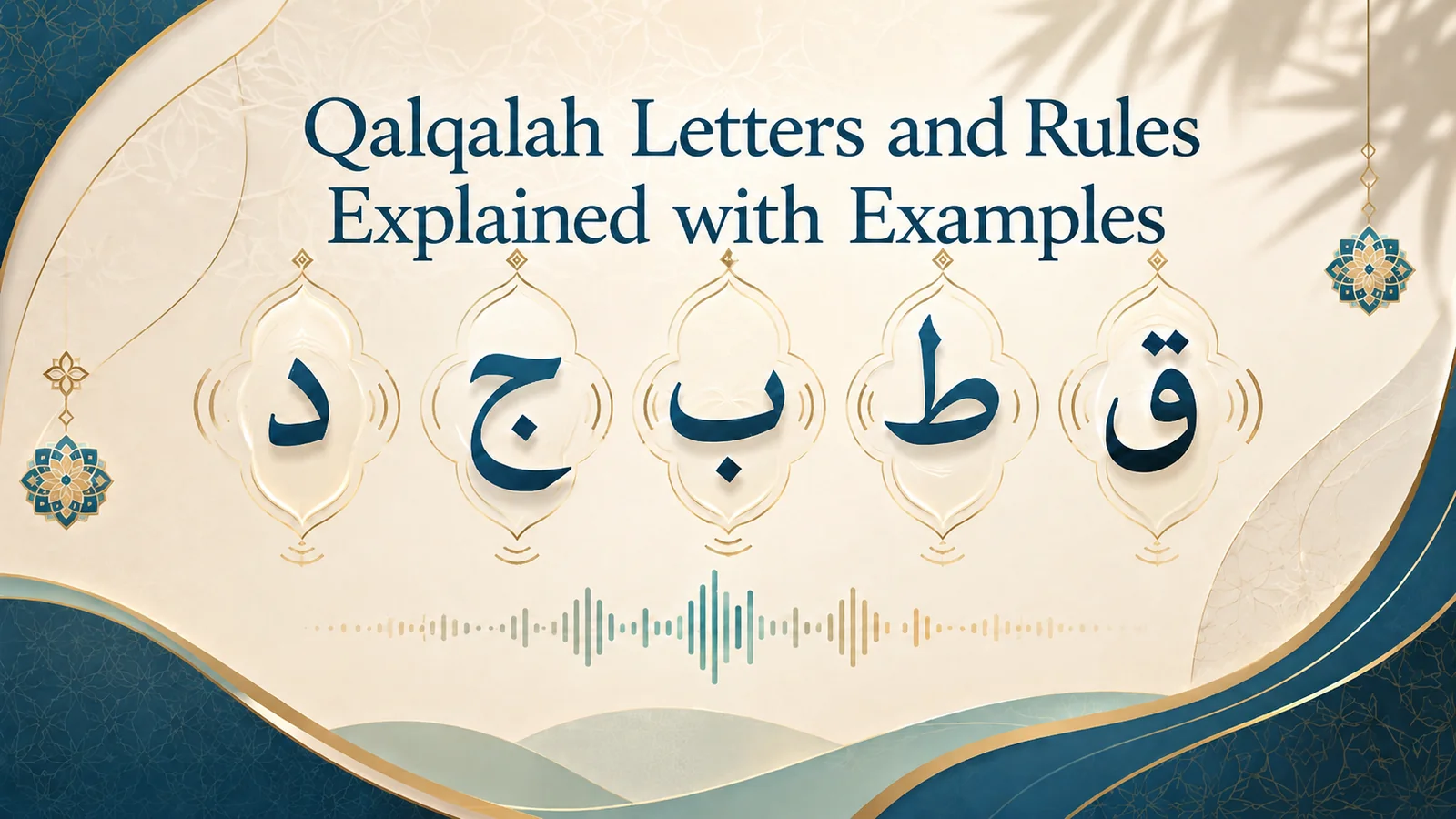
Qalqalah: Echo Sound
Qalqalah is a light echo sound. It applies to these letters:
ق ط ب ج د
Beginners should not turn Qalqalah into a new vowel. It is not “qa,” “ta,” or “ba” added to the letter. It is a controlled echo when the rule applies.
Stopping and Pausing
Stopping affects how the end of a word is read. A beginner may read the ending the same way in every situation, but Quran recitation has rules for stopping and continuing.
At the start, learn where to pause safely. Later, study the signs of Waqf and how endings change when you stop.
Common Pronunciation Mistakes
Most beginner mistakes follow a pattern. That helps. Once the teacher knows the pattern, the correction becomes more focused.
Confusing Similar Letters
Non-Arabic speakers often confuse letters such as:
- ح and ه
- ع and أ
- ق and ك
- ص and س
- ض and د
- ط and ت
These pairs need correction from someone who can hear the difference. A learner may feel they are close enough, but in Quran recitation they are separate letters.
Making Heavy Letters Light
Heavy letters need fullness in the mouth. If a student reads ص like س, or ط like ت, the sound becomes weak.
This does not improve by reading faster. It improves by isolating the letter, repeating it, then reading it inside words.
Stretching the Wrong Sounds
Some learners stretch sounds because they like the melody of recitation. Melody should not control the rule.
Stretch Madd where Madd is required. Keep short vowels short. Do not copy a tune before you understand the sound.
Depending Only on Transliteration
Transliteration may help a new learner start, but it cannot fully carry Quranic Arabic pronunciation.
For example, English letters cannot show the real difference between ح and ه, or between ع and أ. A student should move toward Arabic script as early as possible.
This is where a structured beginner program such as Noorani Qaida online can help students build letter recognition, vowel reading, and basic pronunciation step by step.
How to Practice Step by Step
Good practice is not complicated. It is regular, focused, and corrected.
Start with Letters Before Long Recitation
Do not rush into long passages before the letters are stable. Spend time on the Arabic alphabet, especially the sounds that do not exist in English.
Read one letter with Fathah, Kasrah, and Dammah. Then read it with Sukoon. Then read it inside simple words.
Listen to a Reliable Reciter
Listening trains the ear. Choose a clear reciter and repeat short portions. Do not begin with fast recitation.
For beginners, slow and clear recitation is better than copying a beautiful tune. Accuracy comes first.
Record Yourself
Many students hear the mistake only after they record themselves.
Read one short line. Record it. Compare it with the teacher or reciter. Listen for letters, vowels, Madd, and stopping.
Do not record a full page if you are working on one sound. Focused practice gives better correction.
Practice One Rule at a Time
Do not study Makharij, Sifaat, Madd, Ghunnah, Qalqalah, and stopping all in one sitting.
Take one rule. Practice it in letters. Then words. Then short recitation. After that, move to the next rule.
Review Before Memorizing
If you are memorizing, check pronunciation early. Memorizing a mistake makes correction harder later.
Students in Quran memorization online should give attention to recitation quality along with memorization review. Hifz and pronunciation should support each other.
When a Teacher Is Needed
A teacher is not only there to explain rules. A teacher listens.
This matters because many pronunciation mistakes are hard for the learner to notice. You may not hear that your ق sounds like ك. You may not notice that your Madd is too short. You may think your ع is correct because it sounds close to you.
A qualified teacher can stop you at the exact sound and correct it before it becomes a habit.
What to Look for in a Quran Teacher
A beginner should look for a teacher who:
- Recites clearly and correctly.
- Can explain basic Tajweed in simple language.
- Corrects mistakes without rushing.
- Understands the struggles of non-Arabic speakers.
- Gives repeat practice, not only lectures.
- Avoids promises of fast mastery.
If local access is limited, online Quran classes may help a learner receive regular listening, correction, and Tajweed guidance from home.
For children, parents should choose a class that teaches gently and clearly. A child needs repetition, encouragement, and correction in small steps. Online Quran classes for kids can support this when the teacher is patient and the lessons match the child’s level.
Final Advice for Beginners
Quran pronunciation for beginners should be built slowly.
Start with the letters. Learn the short vowels. Understand where the sounds come from. Practice Madd, Ghunnah, Qalqalah, and stopping with examples. Read to someone who can correct you.
Do not measure progress by speed. Look instead at whether your letters are becoming clearer and whether old mistakes are being corrected.
If you are unsure where to begin, choose a learning path that gives you teacher feedback, Tajweed correction, Arabic reading support, and steady practice. Your level should match your current recitation, not an unrealistic promise.
The safest path is simple: read carefully, listen often, accept correction, and stay consistent.
Related Learning Resources
- online Quran classes
- online Quran classes for kids
- Quran memorization online
- online Quran recitation classes
- Quran Tajweed course
- Quran memorization courses
FAQs
What are Quran pronunciation rules?
Quran pronunciation rules are the basic rules that help a learner pronounce Quranic Arabic letters, vowels, long sounds, nasal sounds, and stopping points correctly.
Are Quran pronunciation rules the same as Tajweed rules?
Pronunciation is part of Tajweed, but Tajweed is broader. Tajweed also includes rules for elongation, merging, clarity, nasal sounds, and pausing.
What should beginners learn first in Quran pronunciation?
Beginners should start with Arabic letters, short vowels, Makharij, heavy and light letters, and simple reading correction before moving into advanced Tajweed details.
Can non-Arabic speakers learn Quran pronunciation?
Yes. Non-Arabic speakers can improve step by step through listening, repetition, Arabic letter practice, and correction from a qualified teacher.
Is transliteration enough to learn Quran pronunciation?
Transliteration may help at the start, but it cannot show many Arabic sounds accurately. Learners should move toward Arabic script and guided recitation.
Do I need a teacher to correct Quran pronunciation?
A teacher is strongly helpful because many pronunciation mistakes are hard to hear alone. A teacher can listen, correct, and guide the learner before mistakes become habits.
شارك المقالة