Quran Learning
Quran Memorization Schedule for Kids During Summer
A practical Quran memorization schedule for kids during summer, with realistic daily routines, revision time, parent support, and teacher-guided Hifz advice without pressure or exaggerated promises.
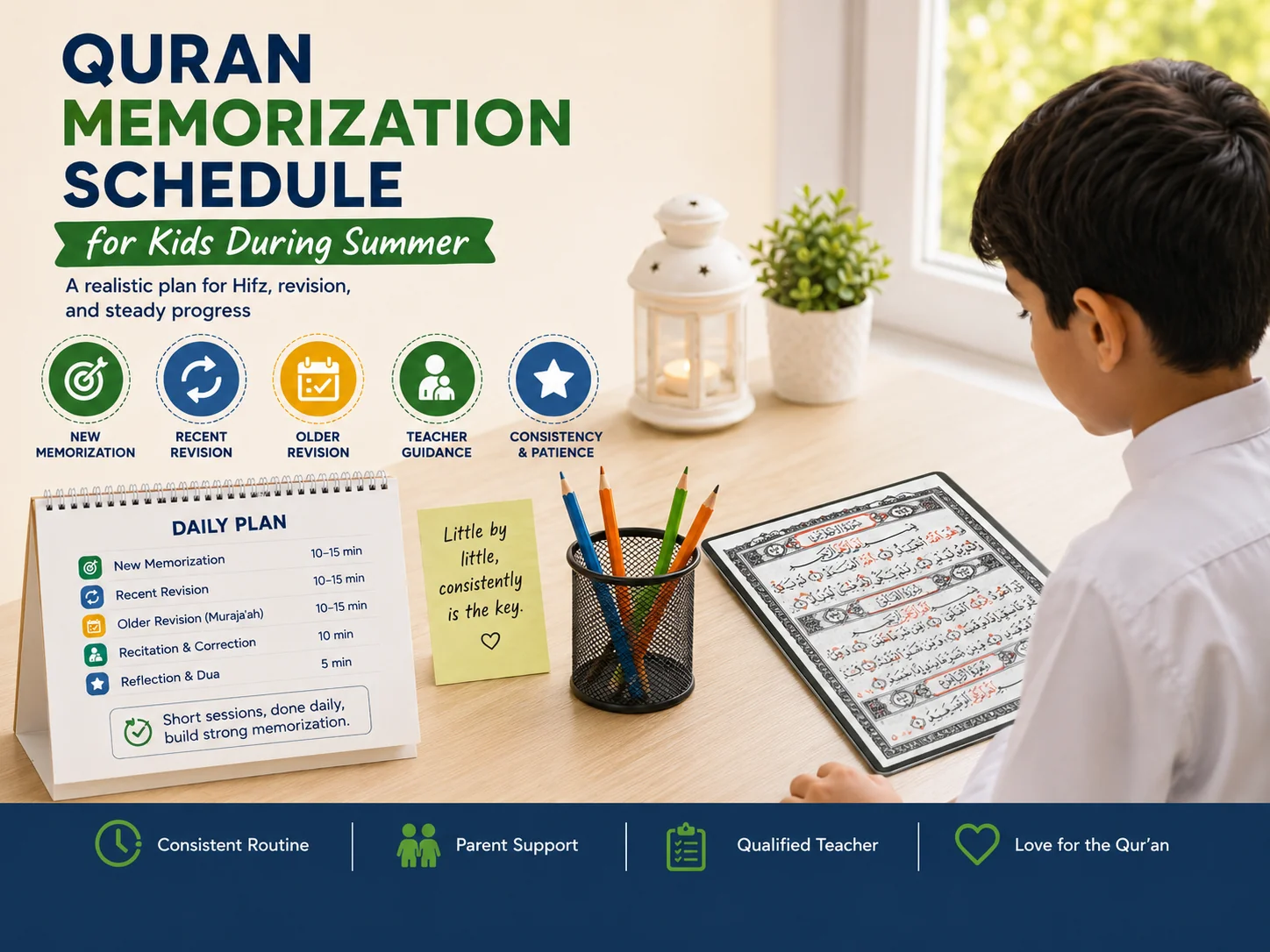
Quran Memorization Schedule for Kids During Summer
Many parents begin summer with a strong Hifz goal, then feel stuck after the first missed day.
The child sleeps late. Family visits change the routine. A trip interrupts the plan. Then the parent starts wondering whether to push harder, reduce the target, or pause everything until school starts again.
A Quran memorization schedule for kids should not fall apart because one day went wrong. It should be realistic enough for summer, gentle enough for children, and clear enough to protect both new memorization and old revision.
The aim is not to make summer feel heavy. The aim is to keep a steady connection with the Qur’an through recitation, memorization, Muraja’ah, and correction from a qualified teacher when possible.
Why Summer Needs a Realistic Hifz Plan
Summer can give children more time. It can also remove the routine that kept their day organized.
During school months, many children wake up, eat, study, and sleep around a known schedule. When summer begins, that structure often becomes loose. That is normal. Children need rest, family time, play, and a break from school pressure.
The mistake is replacing school pressure with Hifz pressure.
A child who was tired from school does not need a harsh summer memorization plan. A child who is still weak in reading does not need a full-page target. A child who forgets old Surahs does not need more new memorization before revision is repaired.
- What can my child recite correctly?
- What can my child memorize without stress?
- What old memorization needs review before we add more?
- Who can correct my child’s recitation?
- How can we continue after missed days?
If the plan ignores these questions, it may look strong on paper and fail at home.
Before You Make a Schedule
Do not begin with the number of pages.
Begin with the child.
Some children are ready to memorize from the Mushaf with teacher support. Some can recite short Surahs by listening and repeating. Others still need help with Arabic letters, joined letters, and basic pronunciation.
If a child cannot read comfortably, Hifz may become slow and frustrating. In that case, a parent may need to begin with Noorani Qaida online or basic Quran reading before setting a larger memorization target.
This is not a delay. It is preparation.
The Three Parts of a Good Hifz Schedule
Check reading ability first
A child who cannot read Arabic letters and joined words comfortably may struggle with memorization. Listening can help, but reading weakness should still be handled.
For some children, summer should focus on reading readiness before larger Hifz targets.
Check attention span
A six-year-old may not sit for thirty focused minutes. A ten-year-old may do better with short blocks than one long lesson.
A teenager may need privacy, ownership, and a clear weekly goal. Do not copy another family’s schedule without looking at your child’s age, energy, and temperament.
Check old memorization
Ask your child to recite what they already know.
Do not test them harshly. Listen calmly. Notice where they pause, mix verses, or need prompts.
Start with revision when needed
If old Surahs are weak, start the summer with revision. New memorization can wait a few days.
A schedule that adds new material while old memorization is slipping will create more work later.
Plan new memorization carefully
New memorization is the new verse, line, passage, or page your child is learning.
For many children during summer, the new portion should be small enough to repeat calmly. One short verse may be enough for a beginner. A few lines may suit a stronger reader. A larger portion should only be used when the child is ready and has teacher guidance.
Include recent revision
Recent revision means reviewing what the child memorized in the last few days.
This part is often ignored. It should not be. New memorization is still soft. If the child does not revise it soon, it can weaken quickly.
Include older revision
Older revision means reviewing older Surahs or portions the child memorized weeks or months ago.
A Quran revision schedule for children should be part of the daily plan. It should not appear only before a test.
A Simple Summer Quran Memorization Schedule
This schedule is a starting point. A teacher may adjust it according to the child’s level.
Daily routine for beginners
Begin with a short session. Five minutes of listening, five to ten minutes of repetition, five minutes of yesterday’s memorization, and five minutes of older revision may be enough.
Total time can be around 20 to 25 minutes. More time is not always better. A short calm session every day is often stronger than a long session that causes resistance.
Daily routine for children who can read Qur’an
A child who can read Qur’an may use a longer routine. Start with five minutes of warm-up recitation, then ten to fifteen minutes of new memorization.
Add ten minutes for recent revision, ten minutes for older revision, and a few minutes for listening again or correcting mistakes. This can be split into two sessions if one long session feels heavy.
Weekly review day
Choose one day each week with no new memorization.
Use it to review the week’s new portion, repair weak parts, recite to a parent or teacher, and check whether the next week’s target is realistic.
Sample Plans by Age and Level
These are examples, not fixed rules.
- Ages 4 to 7: listen to one short Surah daily, repeat one verse or short passage, revise previous short Surahs, and keep the session short if focus is low.
- Ages 8 to 10: memorize one short verse, a few lines, or a teacher-set portion, then revise yesterday’s portion and older Surahs.
- Ages 11 to 13: use a teacher-set portion, revise recent lessons, keep a fixed older revision portion, and include one weekly review day.
- Children weak in reading: focus on Arabic letters, joined letters, short vowels, basic Quran reading, and simple Tajweed correction.
- Busy or travel days: skip new memorization if needed and keep a light Muraja’ah routine.
Do not turn Hifz into a daily battle. If the child resists, reduce the amount and protect the routine.
Common Mistakes to Avoid
Skipping revision
This is the most common mistake.
A child memorizes something new, then moves forward too quickly. After two weeks, old portions become shaky. Sometimes the problem is not memory. It is lack of Muraja’ah.
Making summer too strict
Summer still needs rest.
A schedule that removes play, sleep, family time, and normal childhood may create resentment. The Qur’an should not be presented to children as punishment for having free time.
Comparing children
Do not compare siblings, cousins, or classmates.
One child may memorize faster. Another may recite more carefully. Another may need more time to settle into the routine. These differences matter.
Chasing fast results
A fast plan may look attractive, but Hifz is not only about finishing portions.
It is also about keeping them strong. If the child memorizes quickly and forgets quickly, the schedule needs repair.
Ignoring Tajweed and pronunciation
Children can memorize mistakes if nobody corrects them.
A parent does not need to panic over every small slip, but repeated pronunciation errors should be corrected early by someone qualified.
When Online Hifz Classes May Help
Some families can manage Hifz at home with a local teacher. Others need a more flexible option during summer.
Quran memorization online may help when parents need regular teacher feedback, Tajweed correction, and a schedule that fits travel or changing summer routines.
Online Hifz classes may be useful when parents cannot correct recitation confidently, the child needs a fixed appointment, the family travels during summer, or there is no suitable local teacher nearby.
If your child also needs reading support, online Quran classes for kids may help build recitation before or alongside memorization.
For children who need broader reading, Tajweed, or Arabic support, families may also consider online Quran classes that match the child’s level.
A good teacher should not only move the child forward. The teacher should also help protect what the child has already learned.
Useful Learning Links and Sources
- online Quran classes
- online Quran classes for kids
- Quran memorization online
- online Quran recitation classes
- Quran Tajweed course
- Quran memorization courses
How to Track Progress Without Pressure
Use a simple checklist
Children need encouragement, but not constant testing. A simple checklist can include new memorization, recent revision, older revision, mistakes noted, and teacher feedback.
Do not turn every mistake into a lecture
Mark the mistake. Review it. Return to it later. A calm correction is often more useful than a long speech.
Review weekly
At the end of each week, ask whether the daily portion was too much, which part became stronger, which part needs repair, and whether next week should be lighter.
Celebrate consistency more than quantity
Do not only praise a child for memorizing more. Praise careful recitation, honest effort, revision, and returning after a missed day.
A quiet way to get support
If your child’s summer Hifz plan needs teacher support, AlQuranRecitation.com offers Quran memorization, recitation, Tajweed, Arabic, Noorani Qaida, and Islamic studies classes for different levels.
Final advice for parents
Do not measure the summer only by how much your child memorized. Ask whether your child revised what they already knew, improved their recitation, returned after missed days, and stayed connected to the Qur’an without feeling crushed.
Frequently Asked Questions
What is a good Quran memorization schedule for kids during summer?
A good schedule includes a small amount of new memorization, daily recent revision, older Muraja’ah, and teacher correction when possible. The amount should match the child’s age, reading ability, and attention span.
How much Qur’an should a child memorize each day?
It depends on the child. One short verse may be enough for a beginner, while a stronger reader may manage a few lines or a teacher-set portion. Revision should not be reduced just to add more new memorization.
Should children revise before memorizing something new?
Yes, revision should be part of the daily routine. Many children forget because they keep adding new portions without reviewing recent and older memorization.
What age should children start Quran memorization?
There is no single age for every child. Some children begin young through listening and short Surahs, while others need reading and pronunciation practice first.
Is one verse a day enough for a child?
Yes, one verse can be enough, especially for young children, long verses, or children still improving pronunciation. A small portion done consistently is better than a large target that causes stress.
What should parents do if their child misses a day?
Do not restart the whole plan. Use the next day for revision, reduce the new portion if needed, and continue calmly.
Can online Hifz classes help during summer?
They may help families who need teacher correction, Tajweed feedback, flexible scheduling, or a fixed routine during travel and school holidays.
Share this article
Start Your Quran Journey Today
Book 2 FREE trial lessons with a certified teacher — no credit card required.
Book 2 FREE Trial Lessons