Quran Tajweed
Makharij al-Huroof Explained for Non-Arabic Speakers
A beginner-friendly guide to Makharij al-Huroof for non-Arabic speakers, explaining Arabic articulation points, common pronunciation mistakes, and how teacher feedback can help.
Makharij al-Huroof Explained for Non-Arabic Speakers
You may hear your teacher say, “This letter is coming from the wrong place.” But what does that mean?
You can hear that ح is not ه. You can hear that ق is not ك. Still, when you try to recite, your tongue returns to the sound it already knows.
This is where Makharij al-Huroof helps. It gives you a map of where Arabic letters come from. For non-Arabic speakers, that map can make Qur’an pronunciation clearer and less confusing.
Makharij is not a shortcut to perfect recitation. It is one foundation of Tajweed. With listening, repetition, and teacher feedback, it can help you notice why some letters sound unclear and how to start correcting them.
What Does Makharij al-Huroof Mean?
Makharij is the plural of makhraj. A makhraj is the place where a letter sound comes out. Huroof means letters.
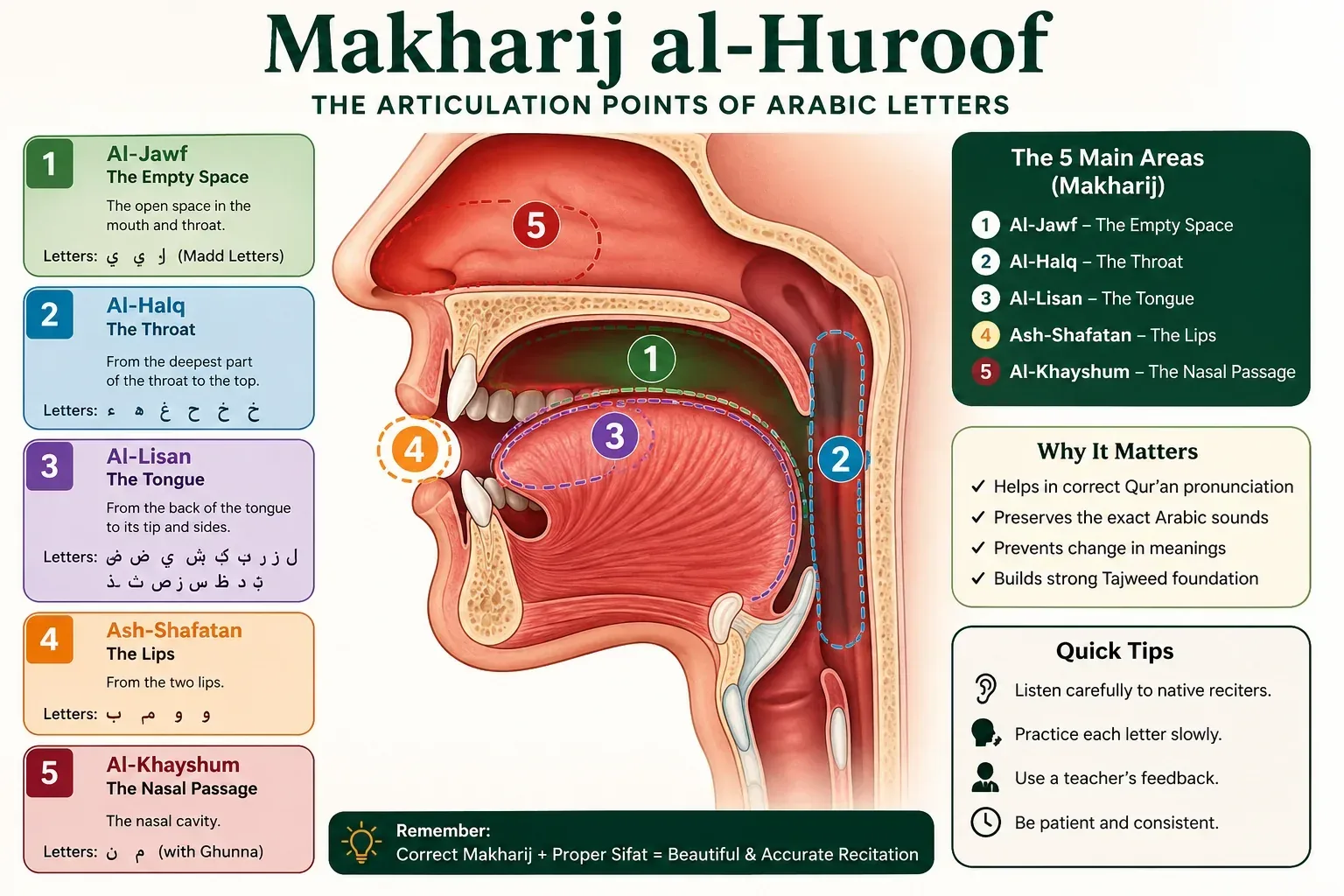
So Makharij al-Huroof means the articulation points of the letters. In Tajweed, it refers to the places where Arabic letters are produced in the throat, tongue, lips, mouth cavity, or nasal passage.
- Some letters come from the throat.
- Some letters come from the tongue.
- Some letters come from the lips.
- Some sounds pass through the open space of the mouth and throat.
- Some sounds include the nasal passage.
Arabic letters are not only different in writing. They are different in how they are produced.
Two letters may look easy to separate on the page. The real difficulty often appears when you try to say them.
For example, ق and ك both involve the back part of the tongue. But they do not come from the same exact place. A beginner may pronounce both like a simple “k” sound. The written letter may be correct, while the sound still needs correction.
Why Makharij Matters in Qur’an Pronunciation
Makharij helps a learner give each letter its own sound. This is part of careful Qur’an recitation with Tajweed.
Some pronunciation mistakes can change the meaning, especially when one letter is replaced with another. Other mistakes may affect clarity, weight, or the quality of recitation.
A careful learner should not panic. But they should not be careless either.
For non-Arabic speakers, the problem is often habit. Your tongue looks for sounds from your own language. If your language does not have ع, ح, خ, ص, ض, or ق, your mouth may replace them with sounds that feel easier.
This is why Makharij is useful for Quran reading for beginners. It changes the question.
Not only, “What does this letter sound like?”
But also, “Where is this sound coming from?”
The Five Main Articulation Areas
Al-Jawf: The Empty Space
Al-Jawf refers to the open space in the mouth and throat. It is linked to the long vowel sounds, known as madd letters.
These sounds do not come from a tight contact point, such as the tongue touching the teeth. They pass through open space.
The madd letters are ا, و, and ي when they function as long vowel sounds. A beginner may cut these sounds too short or force them from the lips or throat. Madd needs separate study, but Al-Jawf helps you understand why these sounds feel open.
Al-Halq: The Throat
Al-Halq means the throat. Six letters come from different parts of the throat: ء, ه, ع, ح, غ, and خ.
These letters are often difficult for non-Arabic speakers because many languages do not use the throat in this way.
For example, ح is not the same as ه. The letter ه is lighter and more open. The letter ح has more throat pressure. A learner may need to listen many times before the difference becomes clear.
Al-Lisan: The Tongue
Al-Lisan means the tongue. This is the largest articulation area. Many Arabic letters come from different parts of the tongue touching or coming close to different parts of the mouth.
This includes letters such as ق and ك from the back of the tongue, ج, ش, and ي from the middle area, ض from the side of the tongue, and several letters from the tongue-tip area.
The tongue is where many Quran letter pronunciation mistakes happen. A small movement forward or backward can make the sound unclear.
Ash-Shafatan: The Lips
Ash-Shafatan means the two lips. Some letters are produced from the lips, or from the lips working with the teeth.
For example, ف uses the lower lip with the upper front teeth. ب and م use the closing of the lips. و uses lip rounding when it is not a madd letter.
These letters may look easier than throat letters, but they still need care. For example, م also carries ghunnah, a nasal quality, in some Tajweed rules.
Al-Khayshum: The Nasal Passage
Al-Khayshum is the nasal passage. It is linked to ghunnah, the nasal sound connected with ن and م.
This does not mean every nasal sound should be exaggerated. Some learners push the nose sound too much. Others remove it completely. Tajweed rules explain when ghunnah appears and how it should be controlled.
A Note About the Number of Makharij
Many Tajweed teachers explain these five main areas through 17 detailed articulation points.
Some scholars counted the points differently. So it is better to say that 17 is the common teaching, not the only way scholars have counted them.
Why Charts Are Helpful but Limited
A Makharij chart can help you see where a sound should come from.
But a chart cannot hear you recite. It can guide your practice, but it cannot replace listening, correction, and repeated practice.
Letters Non-Arabic Speakers Often Mix Up
Many non-Arabic speakers do not struggle with all letters in the same way. The biggest problems often come from pairs that sound close to the beginner’s ear.
ح and ه
Both are throat letters, but they are not the same. ه is softer and more breath-like.
ح needs more pressure from the middle throat. A beginner may pronounce both as “h,” which can make recitation unclear.
ع and ء
The letter ع has no simple English match. Many learners replace it with ء or with a vowel sound.
This often happens because the learner hears a throat sound but does not yet know how to produce it. A teacher may ask the student to slow down and feel the middle throat.
ق and ك
Both involve the back of the tongue, but ق comes from deeper and higher. ك is slightly closer to the mouth.
Many non-Arabic speakers pronounce ق like ك. This is one of the most common Makharij mistakes.
Makharij and Sifat: What Is the Difference?
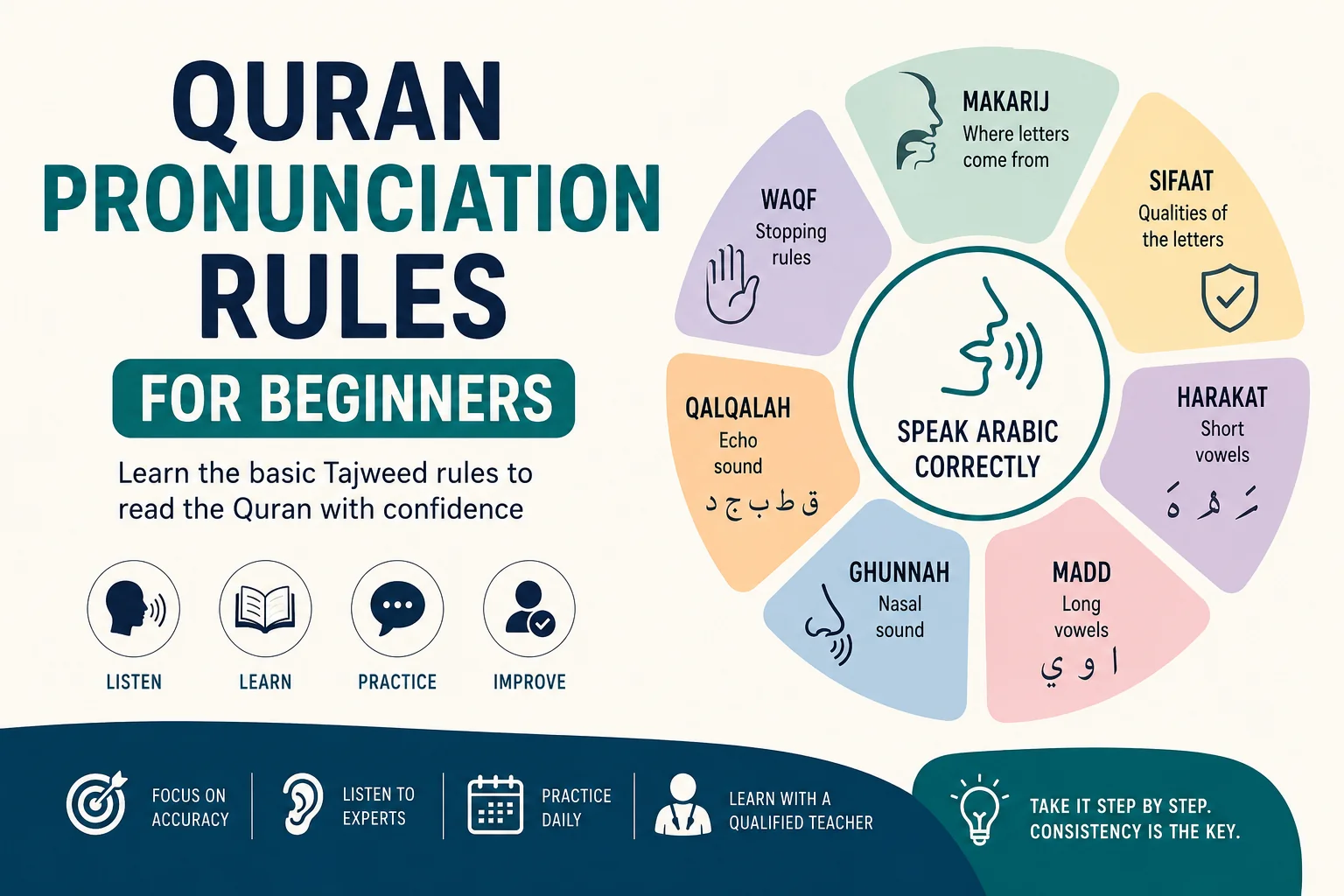
Makharij tells you where the letter comes from. Sifat tells you the qualities of the letter.
- Makharij deals with the place of the sound.
- Sifat deals with the quality of the sound.
- ص and س may feel close, but ص carries heaviness.
- ض is not only about tongue placement. It also needs its correct quality.
- Correct recitation needs both placement and quality.
This is why Tajweed rules for beginners should not teach Makharij as theory only. A learner needs to know the place of the letter and the quality of the letter.
Still, Makharij is a good starting point. If the letter comes from the wrong place, its qualities become harder to apply correctly.
How to Practise Makharij Without Guessing
Listen Before Repeating
Before you repeat a difficult letter, listen to it several times. Do not rush to copy it after one hearing.
Choose one sound, such as ح. Listen for it in short words. Then compare it with ه. Your ear needs training before your tongue can follow.
Practise One Letter Group at a Time
Do not try to fix every letter in one session.
Start with one group, such as throat letters, back tongue letters, tongue-tip letters, lip letters, or ghunnah sounds.
Use Simple Syllables
Practise letters with short vowels before moving into long phrases.
For example, practise حَ حِ حُ, then عَ عِ عُ, then قَ قِ قُ. This helps you focus on the letter itself before reading a full verse or long passage.
Record Your Recitation
Recording can help, but it has limits. You may hear that something is wrong without knowing how to fix it.
Use recording as a mirror, not as your only teacher. Compare your sound with a reliable reciter or with your teacher’s correction.
Connect Makharij With Noorani Qaida if You Are a Beginner
If you are still learning the Arabic alphabet for Quran reading, Noorani Qaida online can help build letter recognition, vowel reading, and early pronunciation habits.
This matters because some students try to study advanced Tajweed before they can read letters and vowels steadily. That usually creates more confusion.
When Should You Study With a Teacher?
You can understand the idea of Makharij from reading, charts, and videos. You can also begin training your ear through careful listening.
Teacher feedback becomes important when you cannot tell whether the sound is correct. This is common with ع, ح, ق, ص, ض, and غ.
A teacher can listen to your recitation and tell you what is happening. Maybe your tongue is too far forward. Maybe your throat is too relaxed. Maybe the letter is correct alone but changes when you read it in a phrase.
If you are studying through online Quran classes, ask the teacher to check your Makharij slowly, not only your fluency. If the learner is a child, online Quran classes for kids should give space for repetition without pressure.
Students working on Quran memorization online may also need Makharij review. Memorising with repeated pronunciation errors can make later correction harder.
Related Learning Paths and Sources
- online Quran classes
- online Quran classes for kids
- Quran memorization online
- online Quran recitation classes
- Quran Tajweed course
- Quran memorization courses
Common Questions About Makharij al-Huroof
What does Makharij al-Huroof mean?
Makharij al-Huroof means the articulation points of the letters. In Tajweed, it refers to where Arabic letters are produced during recitation.
Is Makharij the same as Tajweed?
No. Makharij is one part of Tajweed. Tajweed also includes letter qualities, elongation rules, ghunnah, stopping rules, and other recitation rules.
How many Makharij are there?
Many Tajweed teachers teach 17 detailed articulation points grouped under five main areas. Some scholars counted them differently based on how they grouped certain points.
Can non-Arabic speakers learn Makharij?
Yes. Non-Arabic speakers can improve their Makharij with listening, slow practice, and correction. Progress differs from one student to another.
Do pronunciation mistakes always change the meaning?
Not every pronunciation mistake changes the meaning. Some mistakes may change the meaning, especially when one letter is replaced with another. Other mistakes affect clarity or Tajweed quality.
Can I learn Makharij from videos only?
Videos can help you understand and listen, but they cannot always correct your own sound. A teacher can hear mistakes that you may not notice.
Frequently Asked Questions
What does Makharij al-Huroof mean?
Makharij al-Huroof means the articulation points of the letters. In Tajweed, it refers to the places where Arabic letters are produced during recitation.
Is Makharij the same as Tajweed?
No. Makharij is one part of Tajweed. Tajweed also includes letter qualities, elongation rules, ghunnah, stopping rules, and other recitation rules.
How many Makharij are there?
Many Tajweed teachers teach 17 detailed articulation points grouped under five main areas. Some scholars counted them differently based on how they grouped certain points.
Can non-Arabic speakers learn Makharij?
Yes. Non-Arabic speakers can improve their Makharij with listening, slow practice, and correction. Progress differs from one student to another.
Which letters are hard for non-Arabic speakers?
Common difficult letters include ع, ح, ق, ص, ض, خ, and غ because many languages do not have the same sounds.
Do pronunciation mistakes always change the meaning?
Not every pronunciation mistake changes the meaning. Some mistakes may change the meaning, especially when one letter is replaced with another. Other mistakes affect clarity or Tajweed quality.
Can I learn Makharij from videos only?
Videos can help you understand and listen, but they cannot always correct your own sound. A teacher can hear mistakes that you may not notice.
Share this article
Start Your Quran Journey Today
Book 2 FREE trial lessons with a certified teacher — no credit card required.
Book 2 FREE Trial Lessons