Quran Tajweed
Learn Quran with Tajweed Online: Beginner Roadmap
A beginner roadmap for learning Quran with Tajweed online. Understand what to study first, how teacher correction helps, and when to move toward memorization.
Learn Quran with Tajweed Online: Beginner Roadmap
You want to learn Quran with Tajweed online, but you are not sure where to begin. Do you start with Tajweed rules? Do you fix your Arabic letters first? Should your child begin with Noorani Qaida before reading from the Mushaf?
Many beginners get stuck at this point. They open a long Tajweed chart, try to memorize the rules, and feel lost. That is not the best starting point for most students.
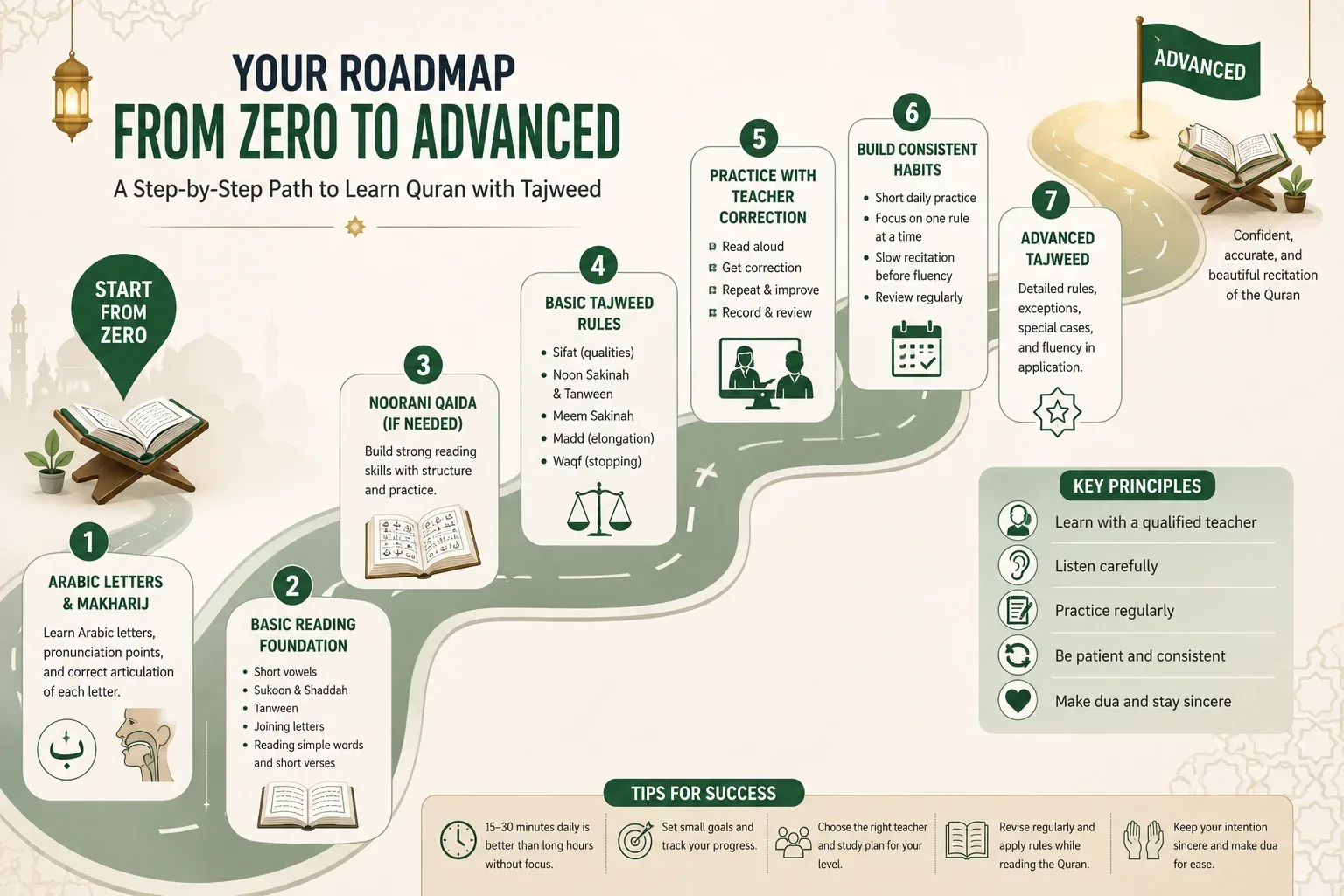
A beginner needs a clear order. First sound. Then reading accuracy. Then simple rules. Then correction and steady practice.
This roadmap explains what to study first, what can wait, and how online Tajweed lessons can support your recitation when they are taught with care.
What Does It Mean to Learn Quran with Tajweed Online?
To learn Quran with Tajweed online means to study Qur’an recitation with a teacher through live or structured online lessons. The student learns how Arabic letters, sounds, and recitation rules are applied while reading.
Tajweed is not only a list of terms. A student may know the names of rules and still recite with weak pronunciation. The goal is to read with more care, pronounce letters from their proper places, and apply the rules during real recitation.
- A clear explanation of the rule
- Teacher demonstration
- Correction while the student recites
- Short practice between lessons
- Review of repeated mistakes
Without correction, a student may understand a lesson in theory but struggle to use it while reading.
Who Is This Roadmap For?
This roadmap is for students who want a steady path. It can help adults, parents, children, sisters, and non-Arabic speakers who want to improve Quran recitation with Tajweed.
A complete beginner may not know Arabic letters well. This student should not begin with advanced Tajweed rules. The first need is letter recognition, vowel reading, and basic pronunciation.
Some adults can read Qur’an, but they feel unsure about their pronunciation. They may pause often, mix similar letters, or read without knowing where mistakes happen. These students often need a level check before starting a full Tajweed course.
Start with Arabic Letters and Makharij
Why sound comes first
The first step is not Madd, Ghunnah, or Waqf. The first step is sound.
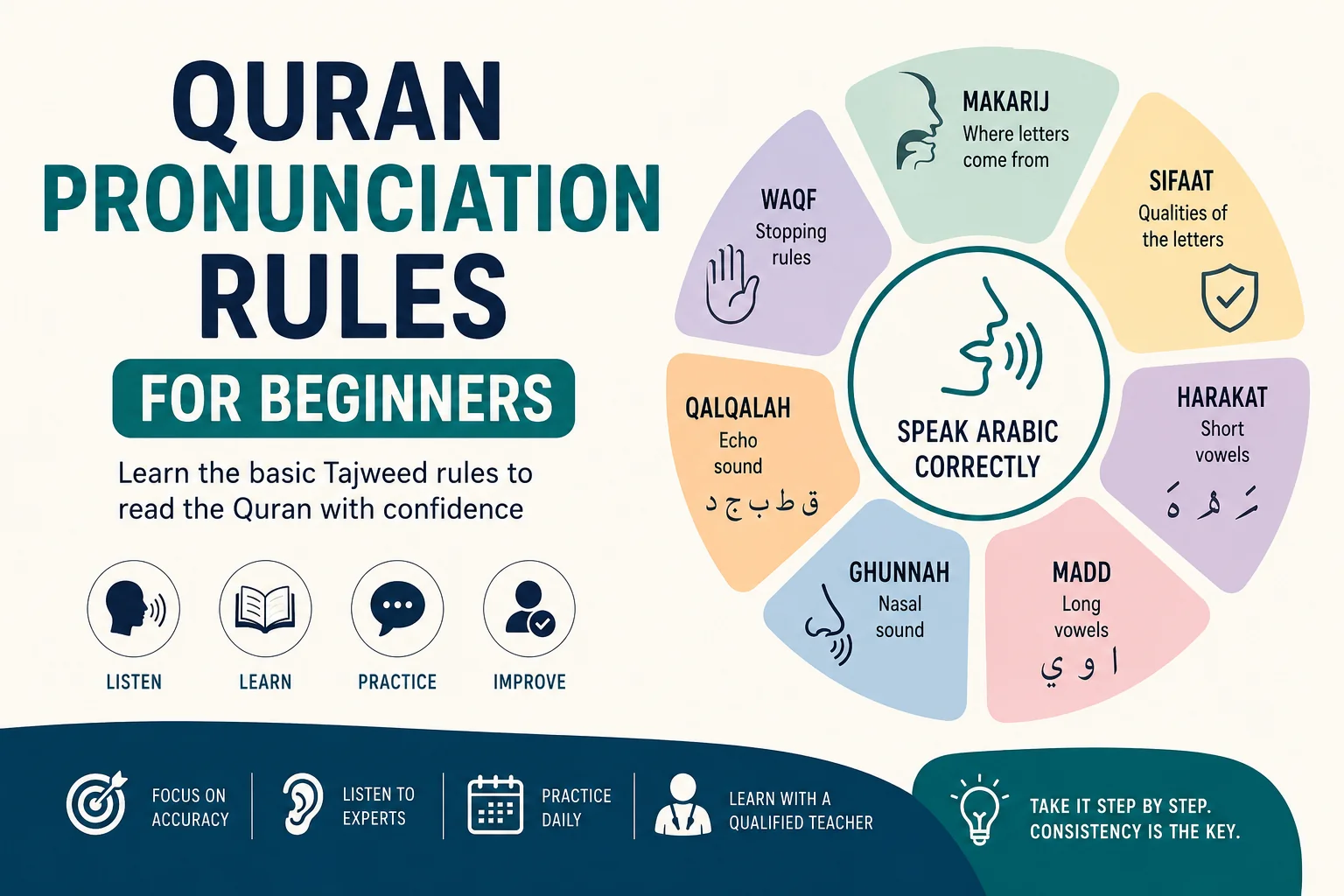
Makharij means the articulation points of letters. In simple words, it means where each Arabic letter comes from. Some letters come from the throat. Some come from the tongue. Some come from the lips.
Why letter sounds come before Tajweed rules
Tajweed rules need correct pronunciation underneath them. If the letter itself is weak, the rule will not fix the reading.
For example, a student may learn a rule about Noon Sakinah. But if they cannot pronounce the surrounding letters correctly, the rule becomes harder to apply.
Letters beginners often confuse
Many non-Arabic speakers need practice with letters such as ح and ه, ع and أ, ق and ك, س and ص, ت and ط, and ذ, ز, and ظ.
The solution is not pressure. It is listening, repeating, and receiving correction from a teacher who can hear the difference.
How teacher correction helps
A teacher can hear small mistakes that the student may not notice alone. This matters because some Arabic letters sound close to beginners, even though they are different letters.
Correction should be clear and patient. The student needs to repeat the sound correctly several times before moving on.
Why children may need more repetition
Children may recognize letters quickly, but their pronunciation still needs practice. Short repetition often works better than long explanation.
Parents should not expect a child to understand every Tajweed term at once. The early goal is careful reading and steady correction.
Why adults should not feel embarrassed
Many adults return to Qur’an reading after years away. Some read slowly. Some mix letters. Some know the words but feel unsure when reading aloud.
A good beginner path should make room for that. The teacher should check the student’s level and begin from the right point.
Why non-Arabic speakers need a slower start
Non-Arabic speakers may need more time with sounds that do not exist in their first language. This is normal.
A slower start can prevent repeated mistakes later.
Build Reading Accuracy Before Advanced Rules
Before advanced Tajweed, a beginner needs stable basic reading. This includes recognizing letters in different positions, reading short vowels, and joining sounds correctly.
Short vowels, Sukoon, Shaddah, and Tanween
A beginner should understand Fathah, Kasrah, Dammah, Sukoon, Shaddah, Tanween, long vowels, and how letters join inside words.
These are not small details. They are the base of reading. A student who reads them carefully will usually find Tajweed rules easier later.
When Noorani Qaida may help
Noorani Qaida can help beginners who need structure with letters, vowels, joining, and basic reading. It is often useful for children and non-Arabic speakers.
If a student can already read from the Mushaf, they may not need to start from the beginning. A teacher can check the student’s level and decide whether they need Qaida review, recitation correction, or direct Tajweed lessons.
Why skipping basics causes problems
Some students want to move straight into Tajweed rules. But if the reading base is weak, the next lessons become harder.
Basic reading is not a delay. It is the foundation that makes Tajweed practice easier.
Learn Basic Tajweed Rules in the Right Order
Once the student can read with some stability, Tajweed rules for beginners can begin. The order matters because some rules depend on earlier skills.
- Sifat, or the qualities of letters
- Noon Sakinah and Tanween
- Meem Sakinah
- Madd, or elongation
- Waqf, or stopping
A beginner does not need to study everything at once. The aim is to understand a rule, hear it, apply it, and review it during recitation.
Practice Quran Recitation with Teacher Feedback
Why listening alone is not enough
Listening to skilled reciters can help, but it is not enough for most beginners. A student may repeat what they think they heard while making the same mistake again.
That is normal. The ear develops over time. Teacher feedback helps train both the tongue and the ear.
How online correction can work
Online Tajweed classes can work when the lesson includes clear audio, direct recitation, and teacher correction. The student should not only watch videos. They should read aloud and receive feedback.
A useful online Tajweed lesson may include review, one new rule or correction point, teacher demonstration, student recitation, correction, repetition, and a small practice task.
What a teacher should listen for
A Quran Tajweed teacher can listen for letters coming from the wrong place, heavy letters read too lightly, light letters read too heavily, Madd stretched too long or too short, unclear Ghunnah, and weak stopping.
These details are hard for beginners to judge alone.
Why recording your recitation may help
Some students improve when they record a short recitation and listen again. This can help them notice pauses, speed, and repeated mistakes.
Recording does not replace a teacher. It supports practice between lessons.
How to build a simple weekly routine
A beginner does not need a heavy routine. A small routine done with attention is better than long practice done without correction.
For many students, a useful pattern is to review one rule, practise a few lines slowly, repeat difficult words, record one short passage, and then read to the teacher in the next lesson.
How to Choose an Online Tajweed Teacher or Class
Choosing an online Tajweed course should not depend only on the title of the page. Look at how the class actually works.
The teacher should listen to the student recite. Tajweed cannot be checked only through written lessons.
A beginner should also know what comes first. The class should not throw advanced terminology at the student before building the reading base.
At Al Quran Recitation Academy, students can study through online Quran classes that include reading, recitation, and Tajweed support according to the student’s level. Children who need a child-focused path can also explore online Quran classes for kids.
If you are unsure where to begin, a short level check with a teacher can help you know whether to start with Noorani Qaida, basic recitation correction, or Tajweed lessons.
Related Quran Learning Resources
- online Quran classes
- online Quran classes for kids
- Quran memorization online
- Noorani Qaida online
- online Quran recitation classes
- Quran Tajweed course
- Quran memorization courses
When Should You Move from Tajweed to Memorization?
Some students want to begin Hifz quickly. This is a good intention, but memorization becomes harder when reading is unstable.
A student may be ready to begin memorization when they can read assigned lines without constant letter mistakes, apply basic Tajweed rules with reminders, repeat after correction, and practise consistently between lessons.
Tajweed correction should not stop during memorization. Many students continue improving their recitation while memorizing. The two can support each other when the teacher gives a balanced plan.
Students who are ready for this stage may look at Quran memorization online after their reading level has been checked.
Final Advice for Beginners
If your letters are weak
Work on Makharij before moving into longer rules.
If your reading is slow
Build accuracy first. Slow reading gives the tongue time to form the letters.
If you know rules but still make mistakes
Read aloud to a teacher. Tajweed should move from the page to the tongue.
If your child is starting
Begin with small steps, short practice, and patient correction.
If you want to memorize
Make sure your reading foundation can carry that goal.
If you are unsure where to begin
Ask for a level check. From there, steady practice matters more than rushing.
Frequently Asked Questions
Can beginners learn Quran with Tajweed online?
Yes. Beginners can learn Quran with Tajweed online when lessons begin at the right level and include teacher correction, reading practice, and steady review.
Do I need to know Arabic before learning Tajweed?
You do not need advanced Arabic, but you do need to recognize Arabic letters and sounds. Some students should start with Noorani Qaida before full Tajweed lessons.
What are the first Tajweed rules beginners should learn?
Beginners usually need Makharij, basic letter qualities, Noon Sakinah and Tanween, Meem Sakinah, Madd, and Waqf in a gradual order.
Should my child start with Noorani Qaida before Tajweed?
Many children benefit from Noorani Qaida first because it builds letters, vowels, joining, and early reading accuracy.
Can listening to reciters replace a Tajweed teacher?
Listening helps, but most beginners still need a teacher to hear mistakes and correct their pronunciation.
When should I start Quran memorization?
It is better to start memorization after the student has stable reading and can follow basic correction.
How often should I practice Tajweed?
Short, focused practice between lessons is usually better than long practice without correction.
Share this article
Start Your Quran Journey Today
Book 2 FREE trial lessons with a certified teacher — no credit card required.
Book 2 FREE Trial Lessons