Quran Learning
Hifz Classes for Kids: What Parents Should Know Before Starting
Before starting Hifz classes for kids, parents should check readiness, teacher style, Tajweed correction, revision habits, and the child’s comfort with regular memorization.

Hifz Classes for Kids: What Parents Should Know Before Starting
“Is my child ready for Hifz, or am I starting too early?”
Many parents ask this after their child memorizes a few short surahs. The child may recite well at home, enjoy listening to Qur’an, or show interest in learning more.
That is encouraging. But it does not always mean the child is ready for a full memorization routine.
Good Hifz classes for kids should not feel like a race. They should help a child build correct recitation, steady revision, confidence with Arabic sounds, and respect for learning the Qur’an.
Before choosing a class, parents need to ask more than, “How fast can my child finish?”
A better question is: “Can my child learn, revise, and continue without pressure?”
What Are Hifz Classes for Kids?
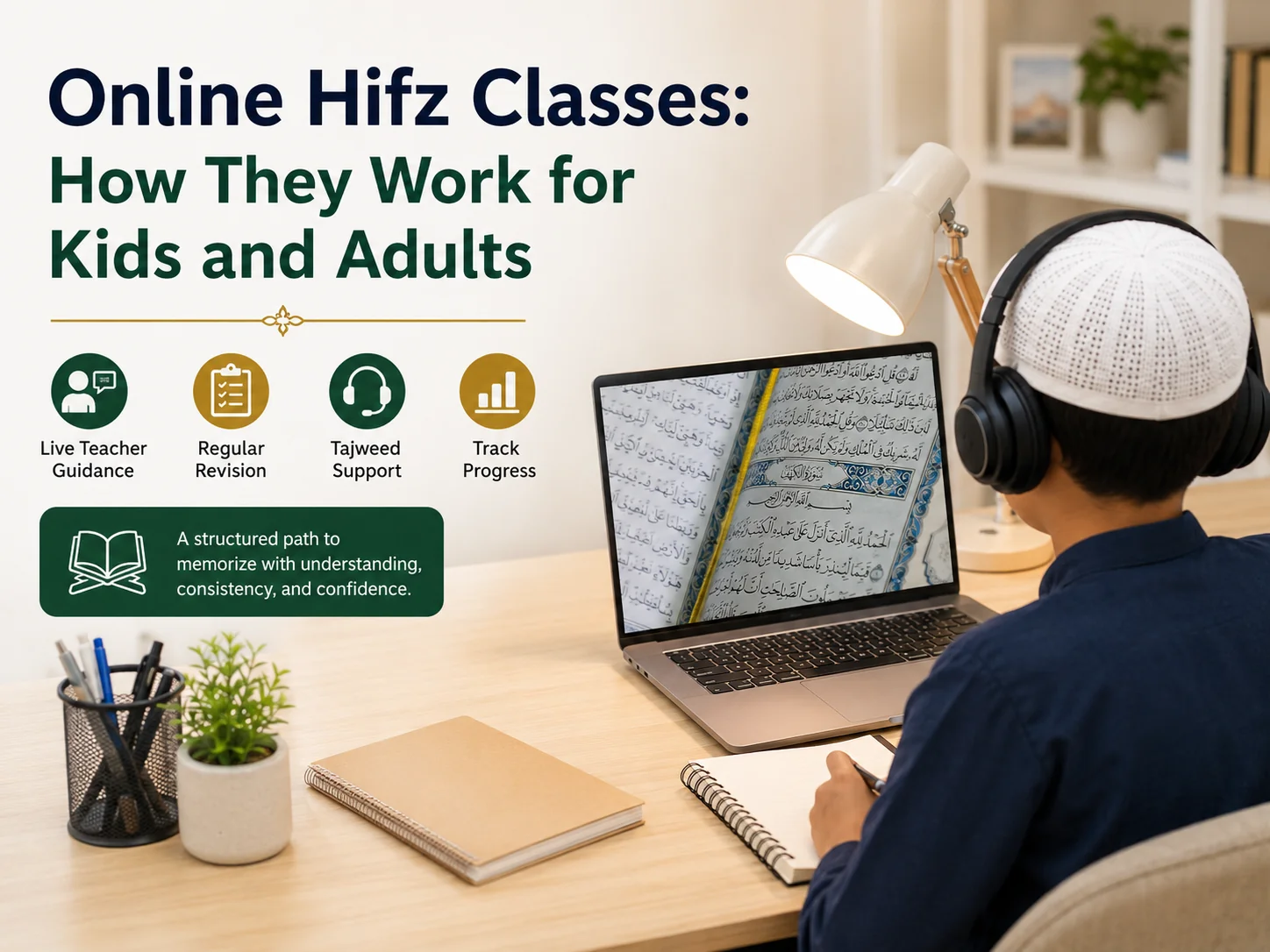
Hifz means memorizing the Qur’an. In children’s classes, this usually includes listening to the teacher, repeating new portions, correcting mistakes, and revising what the child has already memorized.
This is different from general online Quran classes for kids. Some children first need help with Arabic letters, joining words, or basic Tajweed before they begin a regular Hifz plan.
- Revision of previous memorization
- Correction of recitation mistakes
- Listening to the teacher’s recitation
- A small new portion, if the child is ready
- Parent follow-up between lessons
If a class keeps giving new memorization without enough revision, the child may look like they are moving forward while earlier portions become weak.
Is Your Child Ready to Start Hifz?
Age alone should not decide this.
Some children start young and manage well. Others need more time with Quran reading, Arabic letters, or listening practice.
Parents should look at readiness, not only age. A child who can sit for a short lesson, repeat carefully, and accept gentle correction may be ready to begin. A child who becomes distressed before every lesson may need a slower start.
What Should Come Before Hifz?
Quran Reading Basics
Many children can memorize by listening before they read fluently. Still, reading basics matter.
Before a child takes regular Quran memorization classes, parents should check whether the child can identify letters, pronounce common sounds, and follow the teacher’s recitation.
Noorani Qaida for Younger Beginners
Noorani Qaida online can help children build letter recognition, joined sounds, and basic pronunciation. This can make Hifz easier to manage later.
Parents should not treat Noorani Qaida as a delay. For many children, it is the foundation that protects their memorization from repeated reading mistakes.
Tajweed and Correct Pronunciation
Tajweed for kids should be taught in a way children can handle. A young child does not need advanced terms at the start. They need correct listening, gentle correction, and repeated practice.
If a child memorizes with repeated pronunciation mistakes, those mistakes can become harder to fix later. This is why correction matters from the first lessons.
Listening Practice
Listening helps children become familiar with the sound of the portion before they repeat it. It also helps the teacher notice whether the child is copying the sound correctly.
Parents can support this at home by keeping review short and calm, without turning every mistake into a long correction.
Short Surahs and Small Portions
Starting with manageable portions can help a child build confidence. The goal is not to finish a large amount quickly. The goal is to memorize correctly and remember what was learned.
If the portion is too long, the child may repeat words without real retention.
Comfort with Correction
Hifz needs correction. A child should not feel embarrassed every time the teacher stops them.
A good teacher corrects clearly and calmly. Parents should notice whether the child can recite again after a mistake without fear.
A Simple Weekly Routine
Children do better when the routine is clear. A few regular review times during the week may help more than one long session before class.
The routine should fit the child’s age, school schedule, and attention span.
How Online Hifz Classes Should Work
Online Hifz classes can work well when they have structure. The screen is only the tool. The method matters more.
Revision Before New Memorization
Revision should come before new memorization. It shows the teacher what the child has actually retained.
A child who memorized a surah last week may still need several reviews before it becomes stable. Parents should expect revision to take time.
Small New Portions
New memorization should be small enough for the child to repeat correctly.
For some children, that may be one short ayah. For others, it may be a few short lines. The teacher should adjust the amount according to the child’s age, focus, pronunciation, and retention.
Teacher Correction and Parent Follow-Up
In online Quran memorization classes, the teacher should correct recitation clearly. Parents should also know what to review at home.
A simple weekly note can include the new memorization, the old portion to revise, the main pronunciation mistake, and the suggested home review time.
How to Choose a Quran Teacher for Kids
A Quran teacher for kids online needs more than good recitation. Teaching children requires patience, timing, and a calm way of correcting mistakes.
- Does the teacher correct without embarrassing the child?
- Does the teacher give enough revision?
- Does the teacher notice repeated pronunciation mistakes?
- Does the teacher explain what parents should review at home?
- Does the child feel able to recite again after making a mistake?
Some families prefer a female Quran teacher for kids, especially for younger children or girls. Where available, this can be discussed before enrollment. The main point is teacher suitability, comfort, and proper supervision.
The Parent’s Role at Home
Protect the Routine
Parents do not need to become Quran teachers. They need to protect the routine.
Choose a time when your child is not hungry, tired, or rushing to another activity. Ten calm minutes can be better than thirty tense minutes.
Use Encouragement with Care
The Prophet ﷺ said:
Arabic: «خَيْرُكُمْ مَنْ تَعَلَّمَ الْقُرْآنَ وَعَلَّمَهُ»
English: “The best among you are those who learn the Qur’an and teach it.”
Source: Sahih al-Bukhari, Hadith 5027. Sahih al-Bukhari 5027
This hadith shows the virtue of learning and teaching the Qur’an. It should not be used to pressure children or promise guaranteed results. Parents should use it as encouragement with mercy.
Review Without Pressure
If your child forgets, do not treat it as laziness. Forgetting is part of memorization work.
Say, “Let’s revise this again.” Do not say, “You already knew this. Why did you forget?”
Track Retention, Not Only Completion
Parents often count how many surahs the child has finished. That is not enough.
Ask a better question: “Can my child still recite it after two weeks or one month?”
Keep Home Practice Simple
A simple routine can include listening once, repeating slowly, revising an older portion, and stopping before the child becomes exhausted.
This keeps home review steady without turning the home into a second classroom.
Mistakes Parents Should Avoid
Do not start full Hifz only because another child has started. Children differ. A child who needs more reading practice should not be pushed into memorization too soon.
Do not treat Hifz as a race. Fast progress can look impressive in the first month, but the real test comes later. If old memorization is weak, slow down and add more revision.
Do not correct too harshly. Correction is needed, but fear does not help a child love learning. Let the teacher handle technical mistakes. Keep home review gentle and steady.
Questions, Courses, and Sources
- online Quran classes
- online Quran classes for kids
- Quran memorization online
- Noorani Qaida online
- online Quran recitation classes
- Quran Tajweed course
- Quran memorization courses
Frequently Asked Questions
What are Hifz classes for kids?
Hifz classes for kids are Quran memorization lessons that help children memorize new portions, revise older portions, and correct recitation mistakes with a teacher.
What age should a child start Hifz?
There is no single age for every child. Parents should look at readiness, attention, Arabic reading basics, repetition ability, and the child’s comfort with regular lessons.
Should my child learn Noorani Qaida before Hifz?
Many beginners benefit from Noorani Qaida before Hifz because it helps with Arabic letters, joined sounds, and basic pronunciation.
Should Tajweed come before Quran memorization?
Children can begin with simple Tajweed correction while memorizing short portions, but repeated pronunciation mistakes should be corrected early.
How do online Hifz classes for kids work?
Online Hifz classes usually include revision, teacher correction, listening, repetition, and a small new memorization portion when the child is ready.
What should parents do at home during Hifz?
Parents should protect a calm review routine, listen gently, avoid comparison, and follow the teacher’s revision guidance.
How do I choose a Quran teacher for kids online?
Look for correct recitation, child-friendly teaching, calm correction, regular feedback, and a revision plan.
Frequently Asked Questions
What are Hifz classes for kids?
Hifz classes for kids are Quran memorization lessons that help children memorize new portions, revise older portions, and correct recitation mistakes with a teacher.
What age should a child start Hifz?
There is no single age for every child. Parents should look at readiness, attention, Arabic reading basics, repetition ability, and the child’s comfort with regular lessons.
Should my child learn Noorani Qaida before Hifz?
Many beginners benefit from Noorani Qaida before Hifz because it helps with Arabic letters, joined sounds, and basic pronunciation.
Should Tajweed come before Quran memorization?
Children can begin with simple Tajweed correction while memorizing short portions, but repeated pronunciation mistakes should be corrected early.
How do online Hifz classes for kids work?
Online Hifz classes usually include revision, teacher correction, listening, repetition, and a small new memorization portion when the child is ready.
What should parents do at home during Hifz?
Parents should protect a calm review routine, listen gently, avoid comparison, and follow the teacher’s revision guidance.
How do I choose a Quran teacher for kids online?
Look for correct recitation, child-friendly teaching, calm correction, regular feedback, and a revision plan.
Share this article
Start Your Quran Journey Today
Book 2 FREE trial lessons with a certified teacher — no credit card required.
Book 2 FREE Trial Lessons