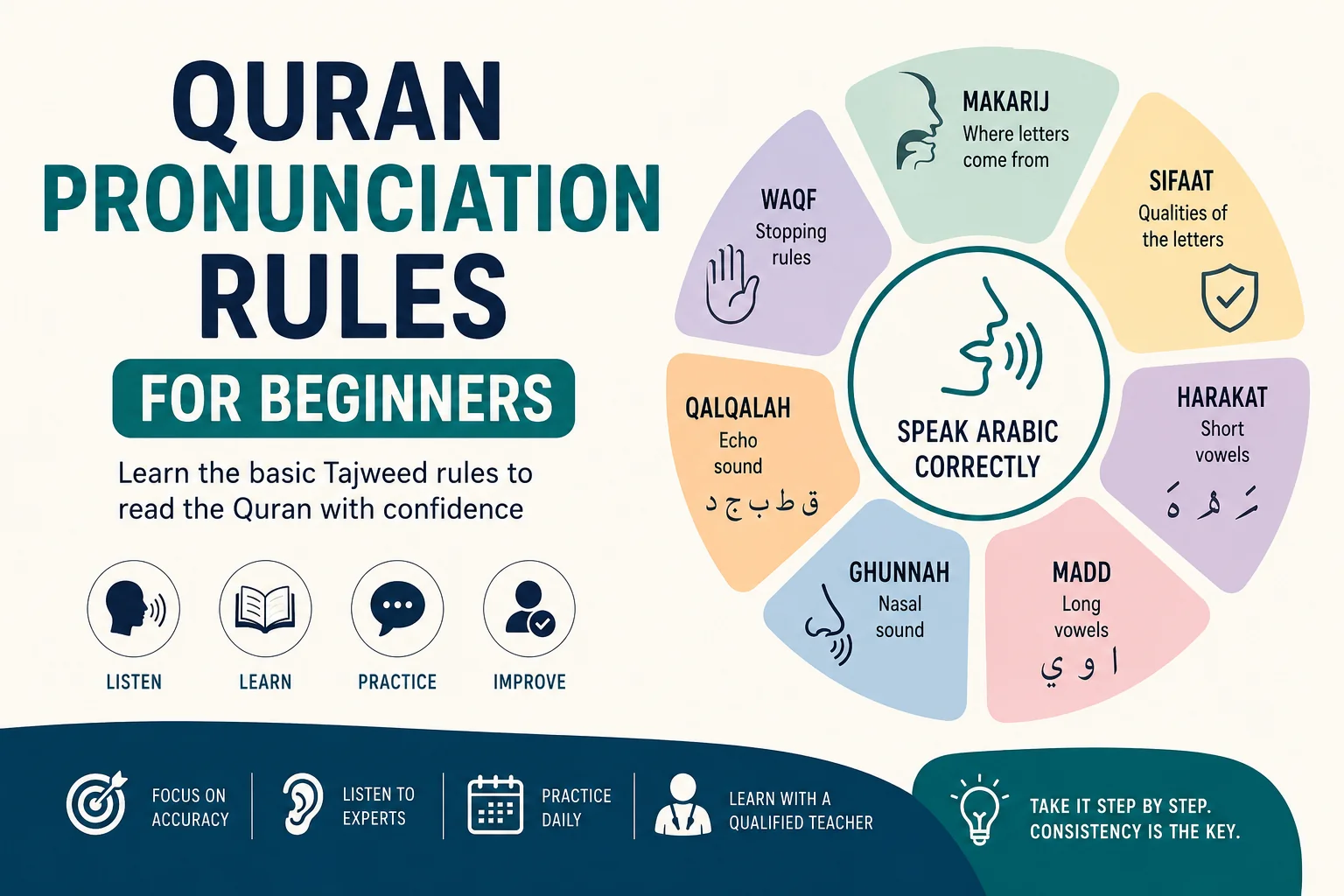
Quran Tajweed
Common Tajweed Mistakes: 10 Errors & How to Fix Them
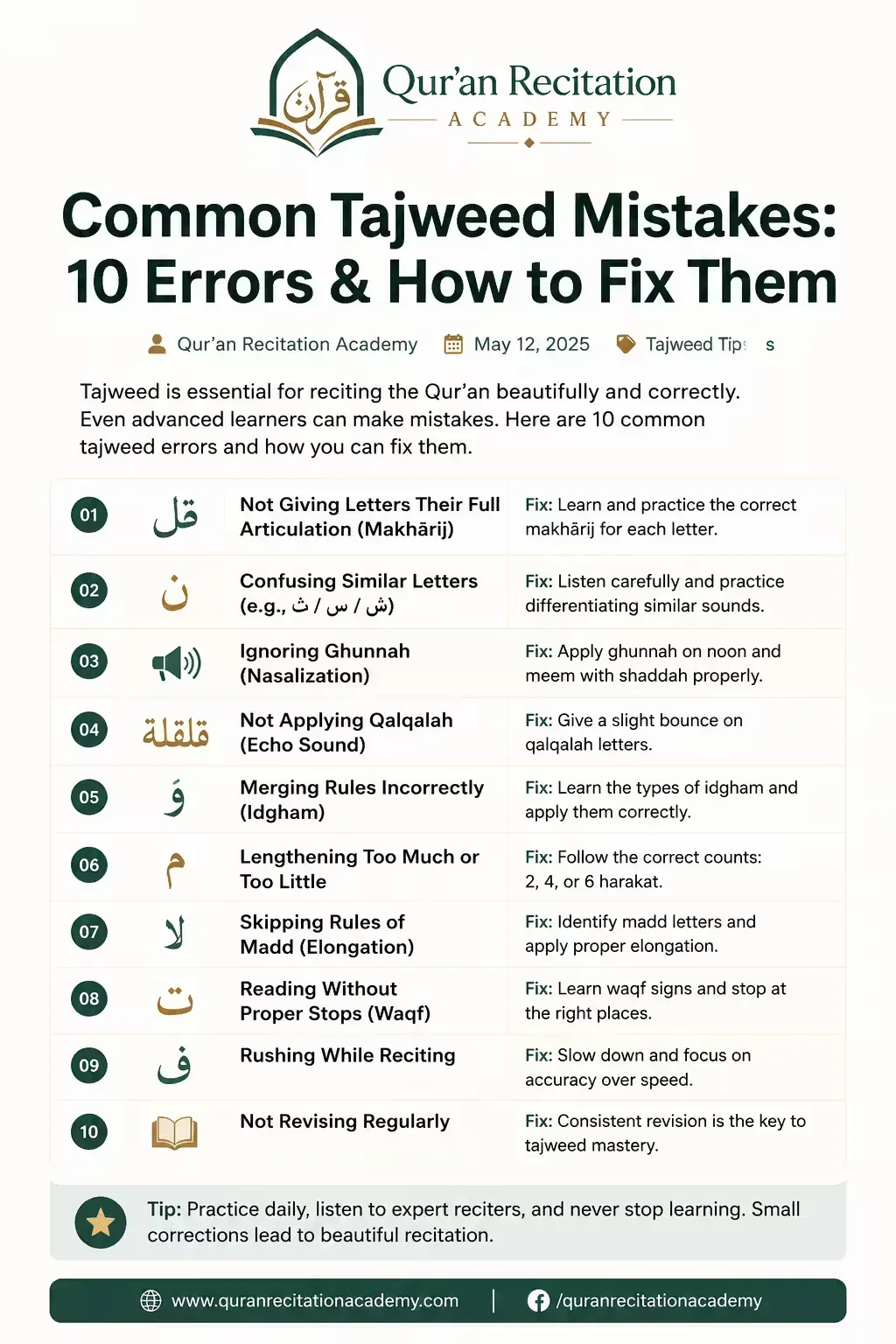
Do you feel like your Tajweed isn't accurate? Have people corrected your pronunciation? Don't worry—you're not alone.
Most Quran learners make the same Tajweed mistakes. The real issue isn't having errors; it's not recognizing them and correcting them. In this comprehensive guide, we'll explore the most common Tajweed mistakes and provide you with practical, effective solutions to perfect your recitation.
Why Tajweed Matters in Your Quranic Journey
Allah (سبحانه وتعالى - Subhanahu wa Ta'ala) says in the Quran:
Tajweed (التجويد) is not just about beautiful recitation. It's a fundamental obligation for every Muslim. When you master Tajweed, you preserve the meanings of Allah's Book as revealed to Prophet Muhammad (صلى الله عليه وسلم - peace and blessings be upon him). Every mistake you correct today is a step toward accurate, Sharia-compliant recitation.
Mistake #1: Ignoring Ghunnah Rules (Nasal Sounds)
Ghunnah (الغنة) is a nasal sound that emerges from the nose when reciting the letters ن (Noon) and م (Meem) with a Shaddah (شدة) (ّ). Many learners either ignore this sound completely or overemphasize it unnaturally.
- Listen carefully: Hear a qualified Qari (قارئ) reciting Surah Al-Fatiha, focusing on the nasal sound in "na'budu"
- Feel your nose: Touch your nose lightly while pronouncing ن (Noon) and م (Meem) with Shaddah (شدة) - you'll feel the vibration
- Count the beats: Hold the nasal sound for exactly two counts (حركتان) (approximately one second)
- Practice daily: Repeat words like "Al-Hamdu lillah" (الحمد لله), "inda Allah" (عند الله - near Allah)
Mistake #2: Applying Madd (Elongation) Incorrectly
Madd (المد) refers to extending the pronunciation of vowel letters (Alif ا, Waw و, Ya ي) for a specific duration. Many learners confuse the different types of Madd (المد), leading to incorrect elongation.
| Type of Madd (نوع المد) | Duration (المدة) | Example (مثال) |
|---|---|---|
| Natural Madd (مد طبيعي - Madd Tabi'ee) | 2 beats (حركتان) | Qaala (قَالَ - he said) |
| Obligatory Connected Madd (مد واجب متصل - Madd Mutasil) | 4-5 beats (أربع أو خمس حركات) | As-Samaa (السَّمَاء - the sky) |
| Permissible Separated Madd (مد جائز منفصل - Madd Munfasil) | 2-4 beats (حركتان إلى أربع) | Ya Ayyuha (يَا أَيُّهَا - O you) |
| Letter Madd (مد البدل - Madd al-Badal) | 2 beats (حركتان) | Amana (آمَنَ - he believed) |
Use advanced Tajweed courses to master Madd (المد) types. Memorize the basic rules and use a metronome app to measure timing accurately.
Mistake #3: Misapplying Qalqalah (The Bounce Sound)
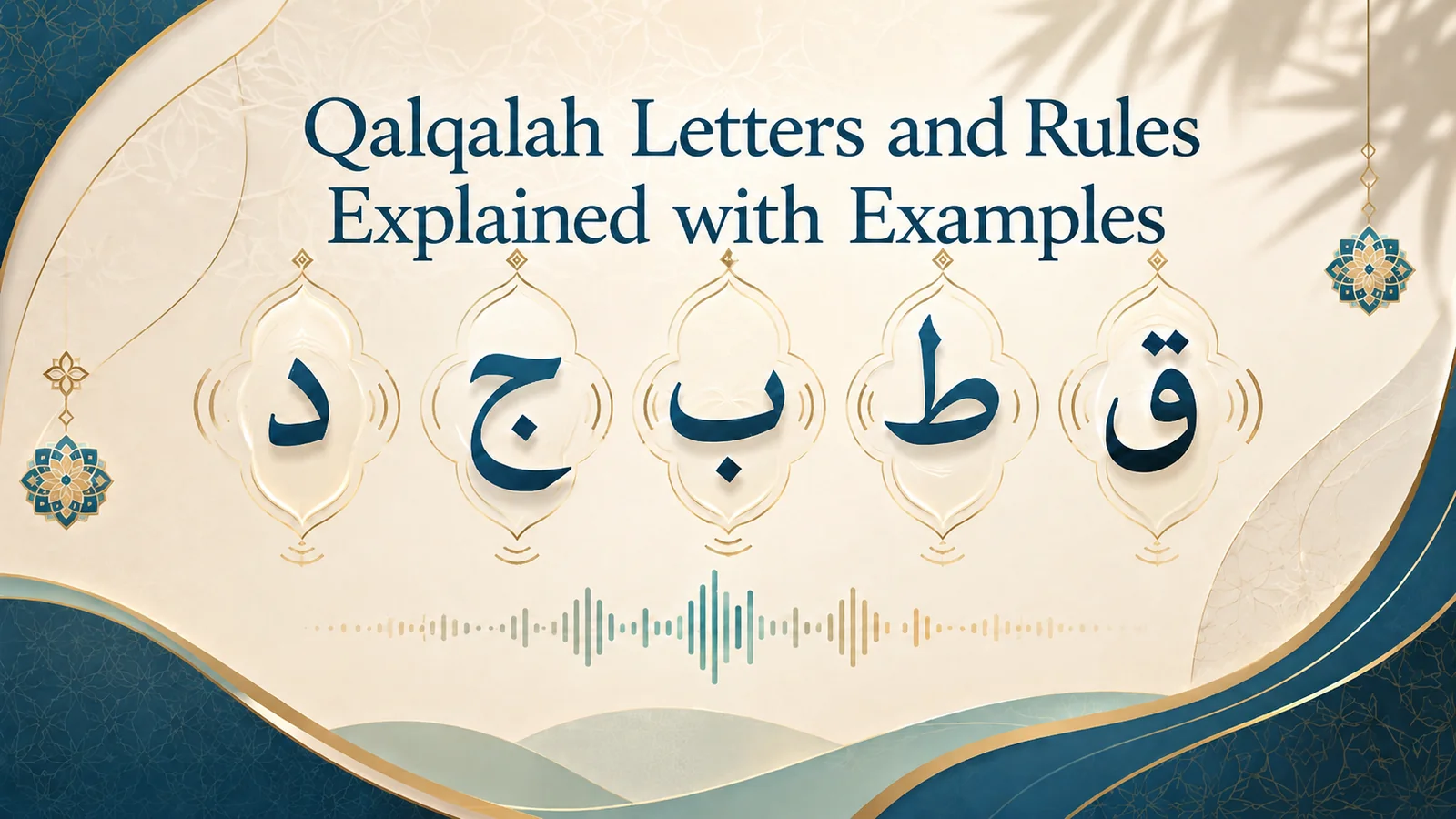
Qalqalah (القلقلة) is a subtle bouncing sound in five letters: ق (Qaf), ط (Ta), ب (Ba), ج (Jim), د (Dal) when they carry no vowel (Sukoon - السكون). Many learners either ignore it or overemphasize it.
Qalqalah (القلقلة) isn't a strong, sharp sound—it's a subtle, reverent bounce. Try simple exercises: say "ab" quickly—you'll hear the qalqalah in the Ba (ب). Say "it" and "aq" the same way.
Mistake #4: Confusing Letter Articulation Points (Makharij)
Each Arabic letter has a specific, precise articulation point (Makhraj - مخرج) in the mouth, tongue, and palate. Confusing these points completely changes word meanings.
| Letter (الحرف) | Common Error (الخطأ الشائع) | Consequence (النتيجة) |
|---|---|---|
| ع (Ayn) | Pronouncing it like ء (Hamza) | Complete meaning change (تغيير المعنى كلياً) |
| ح (Ha) | Pronouncing it like ه (Ha) | Loss of guttural sound (فقدان الصوت الحلقي) |
| ق (Qaf) | Pronouncing it like ك (Kaf) | Heart (Qalb - قَلْب) becomes dog (Kalb - كَلْب) |
- Use a mirror and observe your tongue movement
- Practice similar-sounding letters carefully
- Get help from specialized teachers
Mistake #5: Not Distinguishing Heavy and Light Letters
In Arabic, some letters are heavy (Tafkheem - التفخيم) pronounced with fullness, while others are light (Tarqeeq - الترقيق) pronounced with lightness. Failure to distinguish makes reading flat and spiritless.
Observe the sonic difference between letters by listening to renowned Qaris (قراء) like Sheikh Al-Maaiqli or Sheikh Al-Qadi. Focus on guttural letters (ا, ح, خ, ع, غ, ه) - these need special attention.
Mistake #6: Misapplying Noon and Tanween Rules
Silent Noon (النون الساكنة - Noon al-Sakinah) and Tanween (التنوين) have exactly four rules: Izhar (الإظهار - clarity), Idghaam (الإدغام - merging), Iqlab (الإقلاب - conversion), and Ikhfa (الإخفاء - concealment). Most learners confuse these rules.
| Following Letter (الحرف التالي) | Rule (الحكم) | Example (مثال) |
|---|---|---|
| Ya ي, Noon ن, Meem م, Waw و | Complete Idghaam (إدغام كامل) | Min ya'mal (مِنْ يَعْمَل - from those who work) |
| Ba ب | Iqlab (إقلاب - convert to Meem) | Min bayn (مِنْ بَيْن - from between) |
| Fa ف, Kaf ك, Qaf ق, Ha ح, Kha خ, Ayn ع, Ghayn غ, Ha ه | Ikhfa (إخفاء - concealment) | Min qabl (مِنْ قَبْل - before) |
| Alif ا, Lam ل, Ra ر | Clear Izhar (إظهار واضح) | Min anta (مِنْ أَنتَ - from you) |
Learn Noon and Tanween rules through the Noorani Qaida course. Try practical exercises and listen to the difference yourself.
Mistake #7: Neglecting Silent Meem Rules
Silent Meem (الميم الساكنة - Meem al-Sakinah) has exactly three rules: Idghaam (الإدغام - into another Meem), Ikhfa Shafawi (الإخفاء الشفوي - labial concealment), and Izhar Shafawi (الإظهار الشفوي - labial clarity). Many overlook Meem rules because they focus only on Noon.
| Following Letter (الحرف التالي) | Rule (الحكم) | Example (مثال) |
|---|---|---|
| Meem م | Idghaam (الإدغام - into another Meem) | Bihim muhtalun (بِهِم مُحْتَضَرُون) |
| Ba ب, Fa ف | Labial Ikhfa (الإخفاء الشفوي) | Adhab (عَذَابِ - punishment) |
| All other letters (باقي الحروف) | Clear Izhar (الإظهار الشفوي) | Min an-nar (مِنَ النَّار - from the fire) |
Practice Silent Meem rules the same way you practice Noon rules. Say "hum min" - Idghaam into Meem. Say "adhab" - Ikhfa in Ba.
Mistake #8: Overlooking Letter Characteristics (Sifat)
Each Arabic letter has specific characteristics (Sifat - الصفات) (heaviness, softness, whispering, voicing, etc.) that define pronunciation. Neglecting these characteristics makes recitation flat.
Don't memorize characteristics as pure theory. Listen to the sonic difference between letters through professional Qaris (قراء). Notice the weight and lightness in your own voice. Focus on guttural letters (ا, ح, خ, ع, غ, ه).
Mistake #9: Incorrect Stopping and Starting (Waqf Rules)
Stopping at the wrong place (Waqf - الوقف) can completely change a verse's meaning! That's why Quran manuscripts have stopping marks: م (permissible stop), ج (permissible), صلى (optional prolongation), ۛ (no stop).
- Learn Waqf (الوقف) marks from color-coded Quran manuscripts
- Study verse meanings to understand natural stopping places
- Remember: No stopping before oath particles, no immediate stopping after prepositions
Mistake #10: Rushing Through Recitation Without Tarteel
Allah says:
Tarteel (الترتيل) means slow, measured, consistent reading. Rushing leads to pronunciation distortion and loss of spiritual connection.
- Make your reading intentionally slow - 15 minutes daily with Tarteel (الترتيل) beats 30 minutes rushed
- Use Tarteel apps like Tarteel and Quran Companion
- Follow the Sunnah (السنة): The Prophet (صلى الله عليه وسلم - peace and blessings be upon him) recited with Tarteel taking the entire night
Golden Tips for Correcting Mistakes
💡 Tip #1: Seek a Qualified Teacher
Don't rely solely on yourself. A qualified teacher hears your mistakes before you do. The teacher corrects immediately and provides instant feedback. In reality, you may become deaf to your own errors. Only a professional can break this cycle.
💡 Tip #2: Record and Listen Back
- Record yourself reciting
- Listen multiple times with focus
- Compare with a professional Qari (قارئ)
- Note differences carefully
- Record again after one week
💡 Tip #3: Master One Surah Deeply
Instead of reading multiple Surahs (سور) quickly, choose one (like Al-Fatiha الفاتحة, Al-Ikhlas الإخلاص, or Al-Alaq العلق) and spend two full weeks mastering it. You'll master Tajweed much faster this way.
💡 Tip #4: Active Listening
Passive listening won't cut it. Choose one Qari (قارئ) you love and listen daily for 15-20 minutes. Follow the words in your Mushaf (مصحف) while listening. Try imitating the tones and rhythms. After one month, you'll notice significant improvement.
Available Courses and Programs
If you're serious about correcting your errors, we recommend enrolling in specialized courses:
Internal Courses:
- Advanced Tajweed Course - Comprehensive course covering all Tajweed rules with specialized teachers
- Quran Tajweed Classes - Live interactive lessons
- Noorani Qaida - The right beginning for complete beginners
External Trusted Courses:
- Comprehensive Tajweed Course - Rahiq Academy - Advanced course with certification
- Intensive Tajweed Classes - Rahiq Academy - Focus on practical performance
Frequently Asked Questions
A: Yes, but with difficulty. A teacher accelerates progress significantly. Try starting alone for one month, then join a specialized course.
A: Depends on error count and severity. Usually 2-3 months of consistent daily training.
A: Possibly yes! Repeated errors become habits that are hard to break. It requires more patience.
A: Apps are excellent helpers but not complete substitutes for teachers. Use them to support your learning.
A: Absolutely yes! In Arabic, a small letter mistake can completely change a verse's meaning.
Conclusion and Next Steps
Correcting your Tajweed errors isn't a short journey, but it's a rewarding and blessed one:
- Accept that you make mistakes - It's natural and part of learning
- Identify your errors - Record yourself and listen carefully
- Start with one error - Don't try fixing everything at once
- Ask for help - Join a course or hire a teacher
- Practice daily - Consistency is the secret
- Celebrate progress - Every corrected error is a victory
Remember Allah's words:
Every effort you make to improve your recitation is recorded with Allah (سبحانه وتعالى - Subhanahu wa Ta'ala).
Share this article
Start Your Quran Journey Today
Book 2 FREE trial lessons with a certified teacher — no credit card required.
Book 2 FREE Trial Lessons